Monday, December 15, 2014

Indonesia "still" The Leading Country for Digital Ad Spending Growth


This posting is updated the previous posting on August 2014,
Indonesia The Leading Country for Digital Ad Spending Growth

eMarketer's current update release a few days ago,
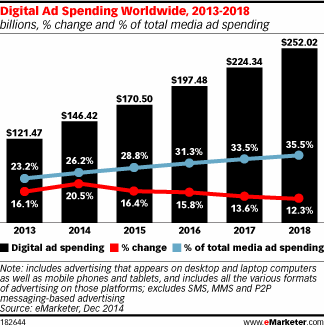
APAC Digital Ad Spending to Jump Over 30% This Year
Dec-2014

China dominates digital ad market; Indonesia sees most impressive growth

Digital advertising spend in Asia-Pacific is expected to rise 30.3% to total $46.59 billion this year, according to eMarketer’s latest estimates of digital ad spending worldwide. (red: previously it is expected to $41.07 billion, though the number of growth seems to be inconsistent)


Just like in 2012 and 2013, the region will boast the second-biggest share of digital ad spending worldwide, trailing only North America, at 31.8% vs. 37.3% (correction from 29.3% vs. 38.8%). This trend will continue through 2016, though Asia-Pacific will gain share during that period at the expense of North America. In 2017, Asia-Pacific will pass North America in total digital ad spending share worldwide, at 36.9% vs. 35.7%.

With investments in online and mobile advertising totaling $23.70 billion this year (updated from $18.96), China will maintain the largest share of the region’s digital ad market, at 50.9% (updated from 46.2%)—a trend that will continue through 2018. Japan and Australia will rank second and third, with respective digital ad spending totals of $9.07 billion and $4.52 billion this year, eMarketer estimates.


In Asia-Pacific, Indonesia will be the leading country for digital ad spending growth by a long shot, at a whopping 98.0% this year (updated from 75%). Indonesia sits at the bottom when it comes to digital ad spending, as brands there still heavily invest in traditional media like TV and print. However, as internet and smartphone adoption continue to grow rapidly, marketers will continue to switch ad spend to digital channels. Over the course of the forecast period, eMarketer expects the country to surpass India and South Korea in digital ad dollars by 2016 and 2018, respectively.

China will also see impressive digital ad spending growth of 45.0% this year, which will be mainly driven by phenomenal gains in the country’s mobile ad market. According to eMarketer’s latest estimates, marketers will spend $6.39 billion on mobile ads in China in 2014, up 600.0% from just $913.0 million last year.

$24Billion for Indonesia's Broadband Expansion

taken from the Reuters.com's article

Telkom to lead Indonesia's $24 billion broadband expansion
FRANSISKA NANGOY AND EVELINE DANUBRATA
JAKARTA Thu Dec 11, 2014 


(Reuters) - State-owned telecom firm PT Telekomunikasi Indonesia Tbk will take the lead in a $24 billion drive to expand Indonesia's broadband capacity over the next five years.

Rudiantara said the government is considering extending unspecified incentives to the company as it seeks to improve Internet access in Southeast Asia's largest economy. "I'm in the position to support Telkom to take a lead on this broadband plan," he told Reuters. The government is in the process of finalizing the details of the plan, he added.

Only 12%  of Indonesia's total population had access to mobile broadband last year, and that was at a relatively slow speed of 512 kbps , according to ministry data. For fixed line broadband, access was even lower at 5% of the total population.

Faster Internet and better access would give a boost to Indonesia's nascent e-commerce market, which the minister estimated could more than double to $25 billion by 2016 from around $12 billion this year.

Rudiantara said the government was discussing incentives with local e-commerce companies such as PT Tokopedia, but he declined to give further details. In October, Japanese technology giant SoftBank Corp and U.S. venture capital firm Sequoia Capital announced a $100 million investment in Tokopedia.

The minister also said the government was considering new regulations for the telecom industry to deal with an anticipated wave of consolidation as companies.  Rudiantara said he expects the number of telecom operators in Indonesia to more than halve to four in the next decade.

A price war to gain subscribers over the last few years and the high operating costs have squeezed the profits of telecom firms including Telkom, PT Indosat Tbk and PT XL Axiata Tbk. XL Axiata, part of Malaysia's Axiata Group Bhd, acquired mobile phone operator PT Axis Telekom Indonesia for $865 million earlier this year. In October, XL Axiata said it will sell 3,500 towers to telecom infrastructure firm PT Solusi Tunas Pratama Tbk in a 5.6 trillion rupiah ($460 million) deal.

Tuesday, December 09, 2014

UGC Streaming Vs TV

Taken from Business Insider's Chart of the Day
YouTube's Revenue Is Catching Up With TV Networks
By Dave Smith, Dec. 8, 2014

Speaking at Business Insider’s IGNITION Conference last week, IAC chairman Barry Diller predicted a major shakeup in the cable and satellite TV model within the next five to 10 years. It looks like digital streaming is already beginning to catch up to traditional TV networks, at least in terms of revenue.

YouTube’s annual ad revenue has been rapidly catching up to that of CBS, one of the biggest and most lucrative TV networks, and has more than twice as much revenue as AMC, which owns several popular shows including “Breaking Bad” and “The Walking Dead.” But CBS hopes to maintain and increase its lead over YouTube by embracing a new model: the company recently announced it’ll have a streaming subscription service available next year that’ll let you watch shows for a monthly fee, similar to Netflix.

Saturday, December 06, 2014

E-Commerce SE Asian profile

Taken from Nielsen's Report
SOUTHEAST ASIAN CONSUMERS FLOCK ONLINE TO PURCHASE PRODUCTS AND SERVICES

Consumers across Southeast Asia are going online in droves, particularly with the rapid up-take of connected devices, and they are increasingly searching out online channels to research and purchase the products and services they need and want. The growth of connected device ownership across Southeast Asia is laying the foundation for a booming online retail sector, with the number of consumers in the region making online purchases increasing significantly in the past two years. Online shopping is set to continue its upward trajectory in the years ahead as consumers’ familiarity with, and trust in, online retail sites grows.

Digital consumers across Southeast Asia enjoy going online to shop, although Filipinos, Vietnamese and Singaporeans are most inclined to purchase items online, while in Indonesia, Malaysia and Thailand consumers are more likely to go online to browse. Reading online reviews, product research and convenience rank among the main factors motivating consumers in Southeast Asia to go online to shop. Notably, a large proportion of Southeast Asian consumers also view the internet as a means of checking out products to inform their offline purchases. This trend, which signals a need for retailers to ensure they do not neglect digital as part of their overall engagement strategy, was most prominent in Indonesia, the Philippines and Singapore where a large number of consumers often look at products online before purchasing them in a store.

Travel services such as airline tickets and tour and hotel reservations are the most commonly purchased items online in Southeast Asia, along with tickets for events such as movies, live performances, exhibitions and sports games. Singaporeans have the highest online purchasing intention globally for airline tickets and hotel and tour reservations, and second highest globally for event tickets; around seven in 10 Singaporeans plan to go online to purchase flights (70%) and make hotel and tour reservations (69%) within the next six months. Malaysians’ online purchase intent is also high, with Malaysia ranking second globally for tours and hotel reservations and third globally for intention to purchase airline tickets and event tickets online. Around half of consumers in Indonesia, the Philippines and Vietnam intend to make travel and event purchases online, along with approximately four in 10 consumers in Thailand.

As e-commerce retailers’ product and service offerings have evolved to meet the demands of online shoppers, the categories which rank most favourably for online shopping have shifted substantially in the past two years; in 2012 categories such as computer and gaming software, mobile phones and clothing and accessories ranked among the most frequently purchased items online. While these categories continue to enjoy high engagement with Southeast Asian consumers when it comes to browsing, the conversion from looking to buying has dropped behind other categories in the past two years.

As Southeast Asian consumers become more familiar with online retailing environments, they are looking to broaden the number of tools and apps they use, both as a means of making their shopping experience easier and more convenient, and also to seek out the best deals. Emerging e-commerce capabilities such as grocery list apps and tools and discount alert apps are beginning to gain traction across the region, particularly in Thailand and Vietnam. More than half of Vietnamese netizens (56%) said they use price-saving apps in-store and when planning their shopping trips, and 44 percent manage their grocery list with grocery retailers’ mobile apps and online tools. In Thailand 55 percent use price-saving apps when planning their shopping trips, 44 percent use price-saving apps in-store and 40 percent use grocery retailers’ mobile apps and online tools to manage their grocery list.

Credit card security remains a key concern for consumers across the region with five of the six Southeast Asia markets ranking above the global average with respect to their concern around providing credit card information online. Filipinos are the most cautious when it comes to paying online by credit card (67% do not trust giving their credit card information online), followed by Thais (62%), Indonesians (60%), Vietnamese (55%), Malaysians (52%) and Singaporeans (41%), compared to 49 percent of consumers globally. In order to gain the trust of consumers online retailers must look for opportunities to provide reassurances around online payment security.

When it comes to devices most frequently used to shop online, although PCs dominate in the majority of Southeast Asia markets, use of mobile phones for online shopping is growing in popularity across the region. Increasing connected device ownership in Southeast Asia is by far one of the most significant factors driving the growth of online shopping, and rising affluence, availability of high-speed connectivity and evolving online offerings will compound this effect in the years ahead. The Philippines, Indonesia, Vietnam and Thailand rank in the top 10 markets globally for use of a mobile phone to shop online and all Southeast Asia markets scored above the global average. Tablet usage is also gaining traction as a means of accessing online retail sites, with all Southeast Asia markets except Singapore ranking above the global average for use of a tablet to shop online.

Insights contained in this article are taken from The Nielsen Global Survey of E-Commerce which was conducted between 17 February and 7 March 2014 and polled more than 30,000 online consumers in 60 countries throughout Asia Pacific, Europe, Latin America, the Middle East, Africa and North America.
Tuesday, December 02, 2014

App Business Model


Taken from Vision Mobile brochure of report
App Profits and Costs : The ingredients of a successful app business and how to replicate them

Insight

  • 63% of app developers and companies that care about revenues are below the profit line. 24% of developers make a definite loss and another 39% struggle around breaking even or slightly above that.
  • South Asia stands out as the region with the highest share (37%) of profitable app businesses. West Europe has the highest share of loss-making app businesses, while South America has the largest occurrence of struggling developers (48%). As contract work is gaining ground in South America, the prospects for healthy profits in the region are improving.
  • iOS has the largest share of profitable developers (41%) across all platforms. Surprisingly, iOS also has the most developers (19%) whose losses are in the ‘deep red’, i.e. below the $2,000 per app/month mark.
  • There is a chasm between the revenue models of the old, such as pay-per-download and in-app advertising, and of the new, such as e-commerce and affiliate programs. E-commerce is the most lucrative revenue model at $2,750 in revenues on average per app / month, and also the most profitable; 52% of developers using e-Commerce revenue models report comfortable profits.
  • Guns For Hire (developing apps on commission) are the most profitable developer segment, as 54% of Guns For Hire make more than $2,000 per app per month. Product Extenders (non-mobile business extending to apps) are the biggest spenders, their median expenditures reaching $2,400 per app per month.

There is a chasm between the revenue models of the old, such as pay-per-download and in-app advertising, and of the new, such as e-commerce and affiliate programs. E-commerce is the most lucrative revenue model at $2,750 in revenues on average per app / month, and also the most profitable; 52% of developers using e-Commerce revenue models report comfortable profits

Monday, December 01, 2014

Number of Internet user in Indonesia will reach the top five

Taken from eMarketer's article

Internet to Hit 3 Billion Users in 2015
and
India Rivals US as No. 2 Internet Audience

Nearly half the world's population will have regular access to the web by 2018

The number of internet users worldwide will surpass 3 billion in 2015, according to new figures from eMarketer, increasing 6.2% next year to reach 42.4% of the entire world's population.


This year, the internet will reach more than two in five people in the world for the first time as online audience hits 2.89 billion users globally. By 2018, eMarketer estimates, nearly half the world's population, or 3.6 billion people, will access the internet at least once each month.

"Inexpensive mobile phones and mobile broadband connections are driving internet access and usage in countries where fixed internet has been out of reach for consumers, whether that's due to lack of infrastructure or affordability," said Monica Peart, senior forecasting analyst at eMarketer. "While highly developed markets are nearly saturated in terms of internet users, there's significant room for growth in emerging ones; for example, India and Indonesia will both see double-digit growth in each year between now and 2018." (Later eMarketer updated the Indonesia annual growth year 2017 and 2018)


On a country-by-country basis, here are year-by-year other milestones eMarketer anticipates during our forecast period:
2014: Brazil will supplant Japan as fourth-largest internet user population
2015: Mexico will settle firmly into the eighth spot, eclipsing Germany
2016: India will jump the US as the second-largest internet user population
2017: Indonesia will reach the top five, overtaking Japan
2018: China will eclipse three-quarters of a billion users, after showing accelerating growth in each year in our forecast

Indonesia will surpass Japan but remain behind Brazil

In Indonesia, eMarketer already estimates penetration is higher than it will be in India by the end of forecast period. But that also means slower growth in the country, which has the fourth-largest overall population and the sixth-largest internet population this year.


Destined to outpace Japan, but not Brazil, in internet market size by 2017, Indonesia will continue to grow its internet penetration until reaching nearly 47% in 2018. Double-digit growth will be over, however, by 2016, when about two in five residents is online.

While substantial compared to most other countries in the world, the Indian and Indonesian internet markets will continue to be dwarfed by China’s for the foreseeable future.


Thursday, November 27, 2014

Rice has become porridge, business case of investment


Regulation does matter


Taken from The Economic Times's article

This business case remind us that Business Model need to be ensured with the Legal aspect and Regulation Compliance, though sometimes the regulatory issue is possible to be revised for the sake of consumer benefit.

Internet TV startup Aereo Inc files for bankruptcy

Reuters Nov 23, 2014

NEW YORK: Aereo Inc, the online video streaming company backed by media mogul Barry Diller, has filed for bankruptcy protection.

The Chapter 11 filing on Thursday night came five months after the US Supreme Court said Aereo violated broadcasters' copyrights by capturing live and recorded programmes on miniature antennas and transmitting them to subscribers who paid $8 to $12 a month. That decision effectively forbade New York-based Aereo's business model, an attempt to offer a less-expensive alternative to cable television.

Chief executive officer Chet Kanojia said the court decision created "regulatory and legal uncertainty" that proved insurmountable. "A little over three years ago, the team at Aereo set out to build a better television experience for the consumer," Kanojia said in a blog post. "We knew we had touched a nerve, had created something special, and had a built something meaningful for consumers." Ultimately, he said, "the challenges have proven too difficult to overcome." In a filing with the US Bankruptcy Court in New York, chief financial officer Ramon Rivera said getting protection from creditors should provide "necessary breathing room" for Aereo to sell its assets, recapitalize or restructure.

The privately held company had been trying to persuade regulators to declare it eligible for a licence available to cable systems, but Rivera said the timing was "uncertain."

Monday, November 24, 2014

Southeast Asian and China is the fastest growth of Mobile Game Market


Taken from newzoo.com article
Global Mobile Games Revenues to Reach $25 Billion in 2014


Quarterly Global Games Market Update 29102014 expect global mobile game revenues to reach $25 billion in 2014, up 42% on 2013, following strong year-to-date growth in both mature and emerging markets, across smartphones and tablets. As a result, mobile games are on track to replace the traditional console market as the largest game segment by revenues in 2015.

Forecasts Revised Upward Due to Strong & Broad Year-to-Date Growth. 

The growth of the mobile market is broad-based, with both “mature” Western and emerging markets growing fast in 2014. The North American market is now expected to grow 51% year-on-year and Western Europe by 47%. However, the fastest growth can be found in emerging Southeast Asian markets and China (+ 86%). The Japanese market also enjoys strong growth in iOS and Android game revenues, though overall remains stable due to the collapse of traditional feature phone game revenues. Despite a widely reported slump in new tablet unit sales, game revenues on tablets are growing faster than smartphones, cementing the position of tablets as a key gaming device.

According to Vincent van Deelen, Market Analyst at Newzoo: “With the public release of these new forecasts, Newzoo is deliberately countering the sentiment aired in recent months that the mobile gaming market is becoming saturated in mature Western markets, especially the US. This is simply not the case. We are also emphasizing that the recent results of individual high profile companies such as Rovio, King, DeNA and GREE are not necessarily indicative of the state of the mobile market as a whole. It is not in our interest to inflate market figures, but the hard facts have forced us to adjust our estimates upward. We have maintained our year-on-year growth rates toward 2017, ultimately leading to a $40Bn+ market in 2017.“


Mobile to Become World’s Largest Games Market Segment in 2015

The high mobile growth rate is driven by both “organic growth”, lifting the overall market, and “cannibalistic growth”, at the expense of other segments. In addition to the initial casualties of mobile growth (handheld console and online casual and social gaming), Newzoo notes signs of slower growth in (online) PC games and MMOs as spending is diverted to mobile devices. Mobile is now expected to become the largest game segment by revenues in 2015, an astonishing feat given that Apple App Store only launched in 2008.

According to Peter Warman, CEO of Newzoo: “In mature Western markets, we see the battle between iOS and Android shifting toward tablets. In most of these countries, including the US, Android smartphones gross more revenues than the iPhone, but the iPad keeps iOS ahead in overall mobile game spending. Android tablets seem to be in the same position its smartphones were in 4 years ago: fragmented in terms of device specs and a lower share of game and average spending. Amazon’s Kindle Fire is an exception, scoring high on both KPIs, but for now the iPad maintains its lead taking the lion’s share of tablet game revenues.

Because mobile gaming is possible on two of the four screens (Smartphone & Tablet) it could theoretically claim half of consumer spending, leaving the other half for the remaining screens (PC and TV)”.  

Apple’s Game Revenues Could Double Those of Nintendo This Year

The Apple App Store remains by far the biggest single platform in the mobile industry, accounting for about half the mobile games market revenues in 2014, with Google Play a close second. We estimate that Apple and Google will earn close to $4 billion and $3 billion respectively in games revenues in calendar year 2014, explaining the fast growth in Google’s “other revenues” in its recent quarterly results. To put this into perspective, Nintendo’s game revenues amounted to $2.4 billion last year and will likely be slightly lower this year. Other app stores likely to grab a significant market share in Android games include Amazon and several Chinese stores such as 360 Mobile Assistant, Tencent’s MyApp, Baidu Mobile Assistant and Xiaomi’s MIUI. 

Friday, November 21, 2014

Asia-Pacific Online Payment (H2-2014)

Taken from Asia-Pacific Online Payment Methods: Second Half 2014 from ystats.com

Online Payments in the Asia-Pacific Region Grow with E-Commerce


In the region’s largest market, China, online and mobile payments are dominated by local third party payment providers, such as Alipay and Tencent. In November 2014, Alibaba announced that it is planning to spin off its financial services arm controlling Alipay into a separate public company, with the expectation of a market value of no less than USD 25 billion. Meanwhile, other third-party payment providers, such as 99Bill, Lakala Payment and China PnR started expanding their mobile and online payment offerings to in-store payments. The number of online payment users in China neared 300 million in June 2014, while mobile payment users topped 200 million.

One of the region’s mobile payment pioneers, Japan has seen new mobile payment pathways launched this year. Korea-based mobile messaging service Line introduced Line Pay in Japan, while Rakuten Bank, a division E-Commerce leader Rakuten, launched payment transfers through Facebook. To support the growth of online payment methods, the Japanese adopted a plan to enhance the payment system, including improvement of real-time bank transfers. The payment methods most used by online shoppers in Japan are credit card and convenience store payments

In South Korea, last month the government agency regulating finances relaxed its requirement to use the specific software for online payment security, allowing companies to choose any security software. Other innovations in payments include the recent launch of mobile payment service KakaoTalk, by Daum Kakao, operator of the leading mobile messaging platform. Also, phone maker Samsung cooperated with payment processor Yelopay to introduce a Samsung Wallet. The value of mobile payments in the first half of this year grew by more than two times to several EUR billion. 

In Australia, online shopping remains the leading purpose for using credit cards. Mobile payments are on the rise, as the share of payments made via smartphone accounted for a high one-digit share of all remote purchases. Moreover, payments with PayPal are gaining popularity and already account for a small one-digit share of all consumer payments in the country.

Cash on delivery is still the payment method most preferred by online shoppers in India in 2014. The same is true for Pakistan, where credit card payment is offered by only three out of seven major shopping sites. Also in Vietnam cash on delivery and bank transfer are the most popular payment options in B2C E-Commerce. Though electronic payment penetrations lags in these nations, the potential for growth is promising.

Thursday, November 06, 2014

Indonesia Consumer Confidence 2014


From Asia Pacific and Indonesia ANZ-RoyMorgan research.

This posting is the additional information to previous posting.


From 2014 Asia Pacific Consumer Confidence Index, released bay Roy Morgan Research, Indonesia is the highest confidence level compare to 6 other country (China, Singapore, Australia, New Zealand, Thailand, Vietnam) that represent Asia pacific. Indonesia index (156.1) followed closely to China (151.1) but far enough from the average (124.4).


2014 would be the highest yearly index for Indonesia. From data 2005-2014, the lowest index happen on 2008, the year of economic crisis. If we calculate the annual growth from that year, we got 6.2% CAGR.


Indonesian Consumer Confidence, October 2014

Taken from The ANZ-Roy Morgan 

ANZ-Roy Morgan Indonesian Consumer Confidence Dips on Politics in October


HIGHLIGHTS
  • ANZ-Roy Morgan Indonesian Consumer Confidence fell to 158.1 (down 3.1pts) in October, but still 9.1pts higher than it was a year ago in October 2013 (149.0). The main driver of this month’s decrease was less confidence in the economic outlook over the short and long term.
  • Indonesians are less optimistic about economic prospects for the country as a whole. 82.8% (down 4.5ppts) of Indonesians expect Indonesia will have ‘good times’ financially during the next 12 months and 16.1% (up 3.6ppts) said Indonesia will have have ‘bad times’ financially.
  • 92.1% of Indonesians (down 2.4ppts) expect the country as a whole to have ‘good times’ economically over the next five years compared to 6.8% (up 1.6ppt) who expect ‘bad times’ economically.
  • In terms of personal finances, 47% (unchanged) of Indonesians said their families are ‘better off’ financially now compared to a year ago with 8% (unchanged) who said their families are ‘worse off’ financially.
  • Also, 74% (unchanged) of Indonesians expect their families will be ‘better off’ financially this time next year compared to 2% (down 1ppt) who expect their families to be ‘worse off’ financially.
  • Finally, 62% (down 2ppts) of Indonesians said ‘now is a good time to buy’ major household items compared to 35% (up 3ppt) who said ‘now is a bad time to buy’ major household items.


ANZ Chief Economist South Asia, ASEAN & Pacific, Glenn Maguire said:

  • "Political shenanigans and the growing prospect of a near term fuel-price hike are now weighing on the minds of hitherto exuberant Indonesian consumers.
  • "Our survey was largely conducted over the period when Prabowo made a clean sweep of lower and upper house parliamentary appointments and hopes of Jokowi securing a workable majority in the Parliament were perhaps at their lowest. To be sure, some of the decline in confidence aligned with political developments was probably tempered by a well-received response to his official Cabinet announcement.
  • "The large decline in question Economic conditions next year, falling 8.1ppts in the month, suggests the prospects of a fuel price hike is also weighing on confidence. A fuel price hike will surely make a significant dent in sentiment. Indeed, the history of our consumer confidence index data set provides a useful indication of what the likely impact of a fuel price hike will be on the Indonesian economy. We note that consumer confidence took a sizeable hit in June-July 2013 after a 44% rise in retail fuel prices – the first increase in five years.
  • "Given a fuel price hike is imminent, Consumer Confidence looks set to fall in tandem with rising petrol prices. Our consumer confidence index should be providing the timeliest read of any economic data in Indonesia on how the impact will play out and their likely effect on economic activity and financial markets.”