| As TikTok negotiates its potential sale, which must be completed within 90 days to prevent the Chinese-owned app from being shut down in the U.S., it is signing a different sort of deal. | |||||||
TikTok is partnering with UnitedMasters, a music distribution company, to allow artists on the video-sharing platform to distribute their songs directly from the app to streaming services like Apple Music, Spotify and YouTube. UnitedMasters also arranges music deals with brands like ESPN and the N.B.A. The deal is expected to be announced today.
|
Thursday, August 20, 2020
Digital Business Deal TikTok #1
Taken from DealBook Briefing August 17, 2020 TikTok isn’t standing still


Thursday, July 23, 2020
Indonesian Young Consumer & Gaming
Taken from Credit Suisse Research
Institute "Emerging Consumer Survey 2019"
March 2019


Cloud service providers as part of utilities market
Taken from Analysys Mason's Quarterly Report "Cloud service providers may prove to be the utilities of the future, in a market that remains highly competitive" April 2019
According to the Oxford English Dictionary, a utility is “an organisation supplying the community with electricity, gas, water, or sewerage”. Regulators and policy-makers in several parts of the world have started to wonder whether large internet platform businesses, operated by the likes of Amazon, Facebook, Google and Microsoft, may be a new form of utilities. After all, they provide essential services to virtually everyone in many developed markets, and they are often portrayed as new monopolies. This analogy can appear somewhat facile, and more in-depth and thoughtful reviews have sought to break down the comparison into objective features such as network effects, high upfront costs and barriers to entry and the importance of intermediating downstream relationships.
The Furman Review uses a comparison with electricity suppliers to question if online platforms are utilities or not. Electricity is not only a fundamental part of everyday life for most people, but it is also an essential input ⁷into virtually every economic activity; it powers factories, farms and offices. Increasingly, a growing proportion of electricity usage comes from computers: a regularly updated paper suggests that ICT currently uses 8–10% of all electricity worldwide, and that this will grow to 20% by 2025. A third of this usage will be linked to data centres; the large internet companies are all committed to power efficiency and the large-scale use of renewable energy to power and cool their facilities.
A study by Analysys Mason shows that online content and service providers, and in particular, the major global internet companies, have invested around USD70 billion annually in their data centres since 2014. Google is one of the largest private sector investors in electricity generation outside of energy companies.

Data centre facilities are expensive; they are typically designed to use hundreds of megawatts. Data centres and the cloud systems that run on them are complex, fast-evolving and incredibly investment-intensive: AWS added USD8 billion in assets in 2018, representing around a quarter of its entire revenue. Thanks to these investments, every company in the world has access to computing power and infrastructure that is virtually identical to that Amazon, Google and Microsoft use for their own services, thereby reducing the technical barriers to entry into many internet-related markets. Apple and Netflix are good examples of this: they are both major customers of AWS, but are also in direct competition with Amazon for video streaming and mobile and home devices.
Cloud providers are increasingly integrating many more-advanced services into their cloud offering, which allow their customers to use not only their IT infrastructure, but also voice and image recognition software (such as Amazon’s Rekognition or Google’s Vision AI) and pre-established machine learning algorithms (Amazon’s SageMaker or Microsoft’s Azure Machine Learning). Voice interfaces are an interesting development: Amazon, Google, Microsoft and even Apple have all developed mass-market voice assistants, partly as an interface to their services, but also as a basic building block to add to their cloud offering to corporations in sectors where voice commands and voice recognition are important.
This points to the idea that cloud service providers may be the real new ‘utility’, in the sense of an essential input into every aspect of everyday life. They harness a traditional commodity (electrical power) to deliver a new form of input (computing services), which is then delivered to any user worldwide in its raw form or combined with any number of structured services (such as voice recognition, AI-as-a-service and visualisation engines). Internet companies such as Amazon and Google have built huge businesses on platforms and intermediation, but are now growing quickly, partly by opening up the building blocks of their platform services to all.
These internet companies are investing large sums of money into building competing cloud infrastructure across the world. Unlike traditional utilities, these companies offer differentiation across multiple dimensions, and are not natural monopolies. This is partly possible because the internet remains an open, worldwide medium, and access networks tend to be operated and regulated effectively, unlike electricity, which relies on national, closed distribution networks.
Regulators and policy-makers will undoubtedly look into the competitiveness of cloud services soon enough. As they do so, they will need to adapt their analytical toolboxes to the new challenges of cloud services, which are infrastructure- and investment-heavy, yet fast-evolving and heavily reliant on software.
Sunday, May 24, 2020
The Experience Disrupter
Excerpt from MIT Sloan article's The Experience Disrupter by Brian Halligan February 27, 2020
It’s not good enough to have a disruptive product. Your customer experience also needs to shine.
There’s been a massive wave of disruption happening in the consumer world. Taking a Lyft, play Spotify, package from Chewy, workout booked through ClassPass, using Dollar Shave Club, order from DoorDash, and check out movie on Netflix, to name a few.
The same shift is going on in the business world, such as collaborate on Slack, meeting thru Zoom, scarf down from ezCater.
We tend to think about technology disrupters like Google, Intel, iPhone, Tesla. Big technology companies with lots of patents. (In 2018, Intel was granted 2,735 patents, Apple 2,160, and Google 2,070.)1
Companies like Chewy Dollar Shave, and ClassPass are not really technology disrupters. List of 20 companies like that have only about 50 patents total.
Instead, they are a new species of disrupter emerging in economy, called experience disrupters. These organizations all have great products, but they offer even better experiences. How they sell is why they win.
These companies have fundamentally reshaped what their customers come to expect in the experience of purchasing and using their product or service. This is a central insight of Clayton Christensen’s Theory of Jobs to Be Done, which tells us that customers don’t simply buy products or services. They hire them to do a job for them. Doing that job well for customers involves creating the right experiences for those customers, from the moment they begin to think about purchasing the product to their everyday use of that product. It’s an essential part of developing a deep relationship with customers: You solve their struggle for them.
Companies that outmaneuver the competition by excelling at the customer experience. Five things modern adaptations that allow these experience disrupters to run over the incumbents.
They Give You Experiences You Didn’t Know You Wanted
While incumbent companies focus on product-market fit, experience disrupters work on experience-market fit. Product-market fit, when you’ve found the right mix of product for just the right target market, is considered by these companies as necessary but insufficient to get the disruption they’re really after. For experience disrupters, what matters is offering experiences that surround the product and that customers didn’t even know they wanted or could ask for.
Carvana, a killer experience disrupter, was founded in 2012 and was the eighth-largest used-car dealer in the US in 2018.2 It went public in 2017 and has a market cap of roughly $12.5 billion.
Typically, a car dealer inventory is necessary, but insufficient. To get the crazy growth it’s had, Carvana focused on the experience-market fit, to create a whole new way to buy a car, very Amazon-like experience. Choose the price range, mileage, condition, type of car, get alerted when available near you, and view a 360-degree inspection with annotated zoom-in areas to see wear and tear.
The company deals with the department of motor vehicles, taxes, registration, including delivery service and still you can return it. Carvana has taken the cringeworthy process of buying a car and automated it, institutionalized it, and made it awesome.
They Make Interactions Frictionless
The second adaptation is that experience disrupters pull the friction out of each customer interaction. The analogy of mechanical flywheel, the less friction customer interactions have, the faster the flywheel spins. In businesses that are struggling to keep up with experience disrupters, their flywheels are full of friction. Experience disrupters are very good at reducing that tension.
Atlassian, a B2B collaboration software company, is a large company that growing very fast and very profitable, with a market cap near $36 billion.
Like other B2B, it's marketing dept focusing less on generating new leads and more on activating current users and multiplying the number of users and teams within a customer. Instead of fighting the uphill battle for senior-level evaluation of their solution, Atlassian focuses on the ease with which an end user can invite a colleague to a collaborative project.
The most of its transactions happen without the sales team. Salespeople negotiate the highest-sticker-price deals, or straightforward, with no commissions. The purchase price is online, and because they don’t negotiate changes in prices or terms and conditions, the contracting process is not complex — and it’s easily automated. All these decisions eliminate friction at this stage of the sale.
They Personalize the Relationship
The third adaptation is creating a personalized experience. The incumbents offer a more generic experience when they’re prospecting customers, meanwhile experience disrupters didn’t sound like tech people. The way they cater to each customer makes them less like tech companies than like ultramodern hospitality companies.
Thru Netflix’s database, the more we use their product, the better its gets at personalizing its recommendations to us. Netflix suggests new content based on viewing history, but even the finest details — such as the thumbnails that accompany each show — are tailored to an individual user’s browsing habits.
This is also happening at Stitch Fix, an online personal styling company, that went public in 2017 with market cap of $2.4 billion, offers customized clothing selection for customers and also sells the outfits. When Stitch Fix first got started, individual stylists recommended combinations of apparel solely on the basis of lengthy profiles completed by customers about their style preferences and specific measurements.
But Stitch Fix knew the value of data to deepen the accuracy of stylists’ recommendations and to give scale to the business. In addition to the initial customer profile, the company uses feedback from customers on their purchases, which items were purchased together and which were rejected and returned, and fastidious details from its merchandise about the precise measurements, textures, and aesthetics of each clothing option. This arms Stitch Fix with an opportunity to base recommendations that have progressively led to increased purchases over returns, and more additional purchases by repeat customers.
Netflix and Stitch Fix are playing the same game, use lots and lots of data to highly personalize experience. How they sell is why they win.
They Get Customers to Sell for Them
The fourth adaptation is that while the incumbents know how to sell to their customers, the experience disrupters are very good at selling through their customers.
Emily Weiss, founder of Glossier -- a private company estimated valuation at $1.2 billion, started off as a blogger — Into the Gloss, was blowing up with beauty tips, then developing beauty products.
Weiss is next-level and a bona fide experience disrupter to not just create her own content but also encourage and enable her customers to create content. Glossier makes its products available to Top 20 YouTube beauty vlogger, sometimes even prior to public release to build buzz. Thousands of wannabes and micro influencers then imitate the most popular vloggers with their own video reviews. The result is hundreds of thousands of pieces of content out there about Weiss’s products — all created by her customers.
Warby Parker, the eyeglasses company, mail the glasses to prospect customers to try on, they can post photos on Instagram, and ask all their judgy friends which one they like.
They Empower Employees to Make Things Right for Customers
The fifth adaption: Experience disrupters enable customer-facing employees to fix things when they need to.
Traditionally, companies woo customers to make a purchase, but the second that purchase is made, it becomes the customer’s hassle to get service on it if there’s a problem. Experience disrupters make all these details much more customer-friendly.
Online pet store Chewy gives its customer service reps a discretionary budget to create opportunities to build goodwill with customers, and this empowerment allows for a customer experience that feels seamless.
Chewy’s costs to acquire a future customer were very low, and the total lifetime value current customer is now very high.
Experience disrupters know how incredibly significant it feels for customers when there’s a genuine change in the power balance in post-sale interactions.
These experience disrupters think differently, and the founders have a healthy disdain for conventional wisdom. They spend hardly any of their energy extracting value from their customers. Instead, they spend all their energy thinking, “How do I add value for my customers?”.
Here’s a summary of the five points:
- Don’t obsess completely about product-market fit. Obsess about experience-market fit. Embrace your inner Carvana.
- Remember that dollars flow where the friction is low. Mechanically remove friction. Automate like the superheroes at Atlassian.
- Personalize, personalize, personalize. Stop embracing automation without personalization — that’s what people call spam. Think like Netflix. Dust for fingerprints.
- Sell through your customers, not just to them. Let Glossier be your model.
- Rethink how customers get treated after the sale. Look at your terms and conditions. Give your customer-facing employees the tools to make things right. Delight people, the way Chewy does.
REFERENCES
1. J.J. Roberts, “IBM Tops 2018 Patent List as AI and Quantum Computing Gain Prominence,” Fortune, Jan. 7, 2019, https://fortune.com.
2. D. Muller, “Carvana Debuts as No. 8 on Used Ranking,” Automotive News, April 22, 2019, www.autonews.com.
3. L. Smiley, “Stitch Fix’s Radical Data-Driven Way to Sell Clothes — $1.2 Billion Last Year — Is Reinventing Retail,” Fast Company, Feb. 19, 2019, www.fastcompany.com.
Sunday, May 10, 2020
Digital Twins.... a bit Digitization
Excerpt from Deloitte's article Digital twins Bridging the physical and digital 15 January 2020
Digital twins are multiplying as their capabilities and sophistication grow but require integrating systems and data across entire organizational ecosystems.
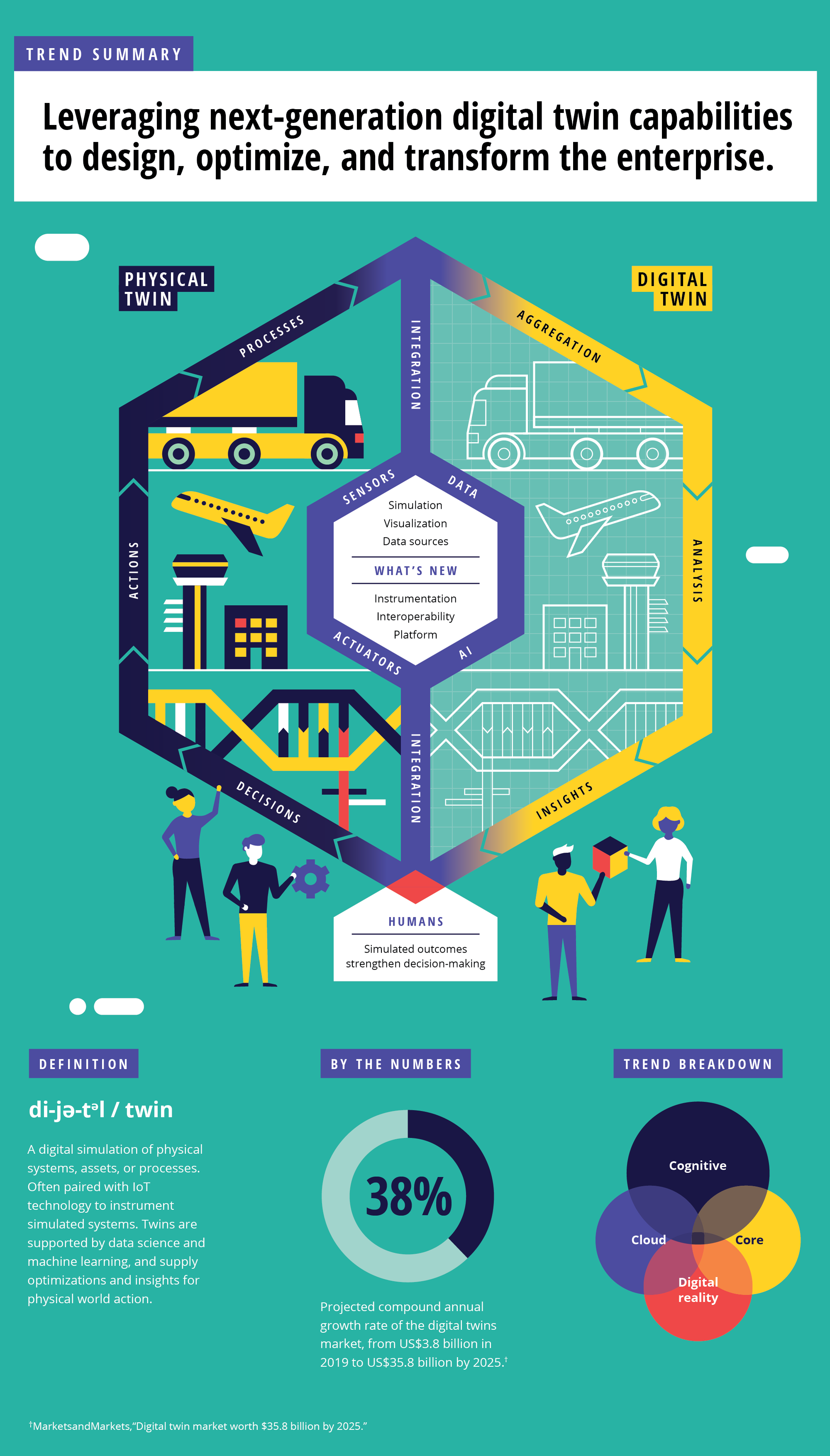

Digital twin would enable you to collaborate virtually, intake sensor data and simulate conditions quickly, understand what-if scenarios clearly, predict results more accurately, and output instructions to manipulate the physical world.
Today, companies are using digital twin capabilities in a variety of ways. They are becoming essential tools for optimizing entire value chains and innovating new products, capturing and analyzing massive amounts of data to build digital models, creating highly accurate diagnoses, uses a detailed virtual model in planning, maintenance, and disaster readiness projects.
Digital twins can simulate any aspect of a physical object or process, but they all capture and utilize data that represents the physical world.
Recent MarketsandMarkets research predict The digital twins market—worth US$3.8 billion in 2019—is projected to reach US$35.8 billion in value by 2025. The trend is gaining momentum thanks to rapidly evolving simulation and modeling capabilities, better interoperability and IoT sensors, and more availability of tools and computing infrastructure. IDC projects that by 2022, 40% of IoT platform vendors will integrate simulation platforms, systems, and capabilities, with 70% of manufacturers using the technology to conduct process simulations and scenario evaluations.
At the same time, access to larger volumes of data is making it possible to create simulations that are more detailed and dynamic than ever.
Models + data = insights and real value
It capabilities began as a tool to streamline the design process and eliminate many aspects of prototype testing. It helps engineers identify potential manufacturability, quality, and durability issues—all before the designs are finalized. Thus moving into production more efficiently and at a lower cost.
Beyond design, it transform the way companies perform predictive maintenance of products and machinery in the field. Embedded sensors feed data in real time, making it possible not only to identify malfunctions but to tailor service and maintenance plans.
It help optimize supply chains, distribution and fulfillment operations, and even the individual performance of the workers involved in each.
Smart city initiatives are also using digital twins for applications addressing traffic congestion remediation, urban planning, and much more.
What’s new?
Digital twin capabilities has accelerated due to a number of factors:
Simulation. The tools are growing in power and sophistication. It is now possible to design complex what-if simulations, backtrack from detected real-world conditions, and perform millions of simulation processes without overwhelming systems. Finally, machine learning functionality is enhancing the depth and usefulness of insights.
New sources of data. Data from real-time asset monitoring technologies can be incorporated into simulations. Likewise, IoT sensors embedded in machinery or throughout supply chains can feed operational data directly into simulations, enabling continuous real-time monitoring.
Interoperability. The ability to integrate digital technology with the real world can be attributed to enhanced industry standards for communications between IoT sensors, operational technology hardware, and vendor efforts to integrate with diverse platforms.
Visualization. Advanced data visualization can filtering and distilling information in real time. The latest data visualization tools go far beyond basic dashboards and standard visualization capabilities to include interactive 3D, VR & AR-based visualizations, AI-enabled, and real-time streaming.
Instrumentation. With IoT sensors improvements in networking and security, control systems can be leveraged to have more granular, timely, and accurate information on real-world conditions to integrate with the virtual models.
Platform. Some software companies are making significant investments in cloud-based platforms, IoT, and analytics capabilities that will enable them to capitalize on the digital twins trend. Some of these investments are part of an ongoing effort to streamline the development of industry-specific digital twin use cases.
Costs versus benefits
The AI and machine learning algorithms that power digital twins require large volumes of data, and in many cases, data from the sensors on the production floor may have been corrupted, lost, or simply not collected consistently in the first place. So teams should begin collecting data now, particularly in areas with the largest number of issues and the highest outage costs. Taking steps to develop the necessary infrastructure and data management approach now can help shorten your time to benefit.
Even in cases where digital twin simulations are being created for new processes, systems, and devices, it’s not always possible to perfectly instrument the process. Organizations need to look to proxies or things that are possible to detect.
Balancing the cost/benefit analysis is critical. Most use cases, however, require only a modest number of strategically placed sensors to detect key inputs, outputs, and stages within the process.
Models beyond
Organizations making the transition from selling products to selling bundled products and services, or selling as-a-service, are pioneering new digital twin use cases. Connecting a digital twin to embedded sensors and using it for financial analysis and projections enables better refinement and optimization of projections, pricing, and upsell opportunities.
Modeling the digital future
More organizations may explore opportunities to use digital twins to optimize processes, make data-driven decision in real time, and design new products, services, and business models.
Longer term, require integrating systems and data across entire ecosystems. Creating a digital simulation of the complete customer life cycle or of a supply chain that includes not only first-tier suppliers but their suppliers, may provide an insight-rich macro view of operations, but it would also require incorporating external entities into internal digital ecosystems. In the future, expect to see companies use blockchain to break down information silos, and then validate and feed that information into simulations. This could free up previously inaccessible data in volumes sufficient to make simulations more detailed, dynamic, and potentially valuable than ever.
Designing Artificial Intelligence (Human-Macine Interaction)
Taken from MIT Sloan Management Review's article Designing AI Systems With Human-Machine Teams March 18, 2020
The greatest potential from artificial intelligence will come from tapping into the opportunities for mutual learning between people and machines.

Artificial intelligence (AI) promises to augment human capabilities and reshape companies, yet many organizations try to implement AI without having a clear understanding of how the technology will interface with people.
Assessing the Context of AI Application
Bringing together the formal rationality of AI and the substantive rationality of humans can help companies meet their goals and optimize the chances of success. However, managers need to assess the decision-making context on two dimensions: (1) the openness of the decision-making process and (2) the level of risk. These will help figure out the teaming options for implementing their AI systems and maximizing further learning.
Openness of the decision-making process. A closed decision-making process implies that all the relevant variables have been considered and that there are predefined rules for framing decisions. An open process, in contrast, anticipates that there will be problems that aren’t well defined and that some variables may not be known in advance.
Closed and open decision-making require different approaches with regard to AI. Closed applications have well-established, structured performance indicators and work with a set of fixed variables. Open system decisions require additional information, often from multiple sources.
Assessments as to whether the process should be open or closed may vary. Consider the challenges involved with language translation that are based on preset rules of grammar and meaning, are therefore closed. In undefined situations, the process might be assessed as open. AI systems such as natural language processing will access contextual information and learn how certain experts handle specific situations.
Level of risk. The severity of a risk depends on the specific elements. An acute risk might be tolerated if the chance of the event occurring is small. Conversely, if the chance is high, the risk may be unacceptable — even if the specific danger is small.
Knowing the risk level can help you decide whether you’ll be comfortable making decisions entirely based on algorithms or whether you’ll want additional resources like human experts on hand to help you handle unexpected situations.
When the contextual factors are well defined, algorithms can “learn” by interacting with the environment through supervised machine learning. In these instances, the need for human involvement is low and act not as active decision makers but as foremen.
By combining humans and machines in AI systems, organizations can draw on four main teaming capabilities:
Interoperability. The interaction needs to be facilitated, systems should be able to share the right piece of information and analysis whenever it’s required. An AI system should also be able to specify the precise role that a human needs to play in the interaction.
Authority balance. In examining dealings, it’s essential to know which one has the final control and when. In low-risk situations, the ability to control for the outcome might be enough. But in high-risk situations, the process might require a more immediate response. The system could also decide to revise how authority is assigned in order to prevent actions that could endanger people or assets.
Transparency. Given the need for reinforcement loops, transparent decision-making processes are key to building trust. The human needs to know which variables, rules, and performance parameters the algorithm uses. At the same time, the machine should know which decisions the human is authorized to make in order to integrate them into the learning loops.
Mutual learning. Machines learn from various sources, including the external environment, repetitive patterns, and the expected versus actual outcomes of decisions. However, they can also develop insights from human experience and intuition. This learning takes two forms: when humans make decisions that the machine analyzes and when human experts train the machines with their intuition. Just as machines learn from humans, humans can acquire insights from algorithms. These two-way learning loops increase the overall scope and performance of the AI system.
Machine-based AI systems. In settings where machine-based designs are central and no surprises are expected, machines can perform tasks independently, with humans playing only supervisory roles and making changes only when necessary. Since potential mistakes are visible and do not pose major risks, the interoperability is for audit purposes only, and transparency is not required.
Sequential machine-human AI systems. In other settings, machines are capable of performing many of their required tasks independently. But humans need to do more than monitor the outcomes — they need to be prepared to step in to deal with unplanned contingencies. This requires humans to have situational awareness and to be ready to identify events that extend beyond the capacity of the machine and intervene. To know when such interventions are required, the AI system needs to have a level of transparency.
Cyclic machine-human AI systems. In settings where the processes are open and low-risk, organizations have wide latitude for shifting decision-making authority from machine to human and vice versa. Even though a high degree of transparency may be needed, as long as the AI system is operating smoothly, the human agents’ task is to monitor the outcomes without intervening in the activity. Their role is that of a coach: to train the AI system by providing new parameters and generally improving the performance.
Human-based AI systems. Decision processes that are both open and high-risk call for human-based AI systems, with the final authority in the hands of humans. Although the AI systems may have enough stored and processed data to make educated guesses, the risk of something bad happening can’t be overlooked. Therefore, experts must maintain high situational awareness. It’s critical, moreover, that the various decision rationales be sufficiently clear and transparent to advance the learning of both humans and machines.
Successful AI implementations should draw on a variety of configurations that can be adapted to the scenario at hand, depending on the environment and human factors.
Closed and open decision-making require different approaches with regard to AI. Closed applications have well-established, structured performance indicators and work with a set of fixed variables. Open system decisions require additional information, often from multiple sources.
Assessments as to whether the process should be open or closed may vary. Consider the challenges involved with language translation that are based on preset rules of grammar and meaning, are therefore closed. In undefined situations, the process might be assessed as open. AI systems such as natural language processing will access contextual information and learn how certain experts handle specific situations.
Level of risk. The severity of a risk depends on the specific elements. An acute risk might be tolerated if the chance of the event occurring is small. Conversely, if the chance is high, the risk may be unacceptable — even if the specific danger is small.
Knowing the risk level can help you decide whether you’ll be comfortable making decisions entirely based on algorithms or whether you’ll want additional resources like human experts on hand to help you handle unexpected situations.
What Role Should People Play?
Combinations of human awareness and AI system design can take different forms, making different configurations possible.When the contextual factors are well defined, algorithms can “learn” by interacting with the environment through supervised machine learning. In these instances, the need for human involvement is low and act not as active decision makers but as foremen.
Interoperability. The interaction needs to be facilitated, systems should be able to share the right piece of information and analysis whenever it’s required. An AI system should also be able to specify the precise role that a human needs to play in the interaction.
Authority balance. In examining dealings, it’s essential to know which one has the final control and when. In low-risk situations, the ability to control for the outcome might be enough. But in high-risk situations, the process might require a more immediate response. The system could also decide to revise how authority is assigned in order to prevent actions that could endanger people or assets.
Transparency. Given the need for reinforcement loops, transparent decision-making processes are key to building trust. The human needs to know which variables, rules, and performance parameters the algorithm uses. At the same time, the machine should know which decisions the human is authorized to make in order to integrate them into the learning loops.
Mutual learning. Machines learn from various sources, including the external environment, repetitive patterns, and the expected versus actual outcomes of decisions. However, they can also develop insights from human experience and intuition. This learning takes two forms: when humans make decisions that the machine analyzes and when human experts train the machines with their intuition. Just as machines learn from humans, humans can acquire insights from algorithms. These two-way learning loops increase the overall scope and performance of the AI system.
Configurations of Teaming Capabilities
Four different ways humans and machines can work together to make decisions.Sequential machine-human AI systems. In other settings, machines are capable of performing many of their required tasks independently. But humans need to do more than monitor the outcomes — they need to be prepared to step in to deal with unplanned contingencies. This requires humans to have situational awareness and to be ready to identify events that extend beyond the capacity of the machine and intervene. To know when such interventions are required, the AI system needs to have a level of transparency.
Cyclic machine-human AI systems. In settings where the processes are open and low-risk, organizations have wide latitude for shifting decision-making authority from machine to human and vice versa. Even though a high degree of transparency may be needed, as long as the AI system is operating smoothly, the human agents’ task is to monitor the outcomes without intervening in the activity. Their role is that of a coach: to train the AI system by providing new parameters and generally improving the performance.
Human-based AI systems. Decision processes that are both open and high-risk call for human-based AI systems, with the final authority in the hands of humans. Although the AI systems may have enough stored and processed data to make educated guesses, the risk of something bad happening can’t be overlooked. Therefore, experts must maintain high situational awareness. It’s critical, moreover, that the various decision rationales be sufficiently clear and transparent to advance the learning of both humans and machines.
Successful AI implementations should draw on a variety of configurations that can be adapted to the scenario at hand, depending on the environment and human factors.
Friday, May 01, 2020
Q4 2019 spend on cloud infrastructure services by Synergy Research Group
Incremental Growth in Cloud Spending Hits a New High while Amazon and Microsoft Maintain a Clear Lead
New data from Synergy Research Group shows that Q4 spend on cloud infrastructure services increased by $2.8 billion over the previous quarter, which is by far the biggest quarterly increment the market has seen. At 37% the YoY growth rate is slowly trending down, but this is due to the massive scale of the market which forces growth rates to moderate.
Meanwhile Amazon growth continued to closely mirror overall market growth so it maintained its 33% share of the worldwide market. Second ranked Microsoft again grew fast than the market and its market share has increased by almost three percentage points in the last four quarters, reaching 18%.
Behind these two market leaders, Google, Alibaba and Tencent are substantially outpacing overall market growth and are gaining market share. All three saw revenues increase by 50% or more year on year.
Four other cloud providers have substantial market share but are somewhat niche players and typically have lower growth rates – IBM, Salesforce, Oracle and Rackspace. There is than a long tail of cloud providers with a small market share.

Synergy estimates that quarterly cloud infrastructure service revenues (including IaaS, PaaS and hosted private cloud services) were well over $27 billion, with full-year 2019 revenues reaching over $96 billion.
Public IaaS and PaaS services account for the bulk of the market and those grew by 38% in Q4. In public cloud the dominance of the top five providers is even more pronounced, as they control over three quarters of the market. Geographically, the cloud market continues to grow strongly in all regions of the world.
The 2019 market was over twice the size of the 2017 market. Given secular trends in the market we will continue to see strong growth. We will also see a continuing battle for market position between the global giants and smaller cloud providers that have a more focused geographic or service footprint.
Tuesday, November 27, 2018
Half of global online retail sales is generated on marketplaces
Source : www.ystats.com
Online marketplaces, such as Amazon, eBay, Tmall and Rakuten, generated around 50% of global E-Commerce sales in 2017, with a projection of two-thirds by 2022, according to sources cited in the yStats.com report. Eight in ten online shoppers used these platforms in 2017 and two-thirds started their product search on multi-seller websites rather than on the search engines of retail shops.
Asia is the global leader of the marketplace trend. In countries such as China, India and Japan, the vast majority of online shoppers reported making half or more of their Internet purchases on marketplaces, according to data from a 2017 survey contained in the yStats.com report. In contrast, only around one-third of U.S. B2C E-Commerce sales was generated by third-party merchants via marketplaces. Nevertheless, more U.S. consumers are turning to marketplace shopping, attracted by better prices and free or discounted shipping options. Other marketplace features luring online shoppers in different countries include product availability and variety.
While popularity of marketplaces among global online shoppers is rising, the rivalry between the top online marketplaces is intensifying. In terms of gross merchandise volume, Alibaba was the leading marketplace operator in the world in 2016, generating two times more online sales than Amazon’s retail and marketplace GMV combined, as yStats.com’s publication shows. Nevertheless, Amazon’s marketplace is also growing, with around one in two units sold on Amazon coming from third-party sellers, as of 2017. Besides the two E-Commerce giants, other leaders in the global marketplace space include eBay, Rakuten, JD.com, Etsy, and Wish, with numerous regional and country champions such as MercadoLibre, Flipkart, Allegro and Jumia.
Indonesia’s B2C E-Commerce to experience the fastest growth in Southeast Asia
Source : www.ystats.com
B2C E-Commerce in Indonesia is growing at high double-digits rates which exceed those in the neighboring Southeast Asian nations. According to projections cited in the report by yStats.com, Indonesia is expected to be the top country in Southeast Asia by online retail sales in 2021 and also rank among the key emerging retail E-Commerce markets globally by 2025. The country’s growing middle class amidst the 260-million population and rising Internet penetration rates contribute to this robust growth.
M-Commerce is the key online retail trend in Indonesia, with mobile accounting for almost three-quarters of overall Internet traffic, as of early 2018. Most unique visitors to the country’s leading online shopping sites such as Lazada, Blibli and Tokopedia come from mobile devices, although the conversion rates on mobile are still lower than on desktop. Another important characteristic of Indonesia’s B2C E-Commerce market highlighted in the yStats.com report is the importance of social media, such as Facebook and Instagram, as a source of inspiration for digital purchases and also as a platform to place orders with online sellers. Clothes and footwear rank as the top product categories transacted through social networks.
At the same time, several major challenges to future E-Commerce growth exist. Indonesia’s archipelago geography complicates the delivery process, while low bank account penetration rates and preference for cash necessitate the acceptance of alternative payment methods by online merchants. Furthermore, Internet penetration in Indonesia is still low, according to statistics cited in yStats.com’s publication, and only about one in three Internet users make purchases online. Nevertheless, the growth expectations are high, attracting large investments into Indonesia’s E-Commerce sector.
Monday, August 20, 2018
Disrupted Phone Call by Chat App
Taken from "Chat apps are extinguishing phone calls"

Annual time spent on mobile calls in the UK fell year-over-year (YoY) for the first time, according to report by UK telecommunications regulatory authority Ofcom. Total mobile call volumes dropped by 2.5 billion minutes (1.7%) last year to 149 billion, down from 151 billion in 2016.
The British regulator attributes the downtick in time consumers spend making phone calls to the rising popularity of mobile messaging apps like WhatsApp and Snapchat.

It's likely this slump will continue as the consumer shift to chat apps swells:
- The chat app consumer base is massive and growing. It's estimated that 1.8 billion people worldwide regularly used such apps by the end of 2017, up almost 16% from 2016, according to eMarketer.
- And chat app users are highly active. For instance, 57% of consumers in the UK were active social chat users on mobile in January 2018, which is up 3% annually. Moreover, Android users in the UK spend 25% of their mobile time in chat apps.
- This shift in consumer behavior is impacting the way consumers want to interact with businesses. 54% of consumers already prefer using social messaging channels for customer engagement over legacy channels like phone and email, and 59% of consumers would rather go through additional channels to contact brands just to avoid having to use their voice to communicate.
As chat apps continue to replace legacy channels of communication, they will present a growing opportunity for brands. For businesses looking to increase engagement with customers, improve retention, and boost sales, it's important to shift focus to where customers are already spending a good chunk of their time.
Chat apps provide tools to help businesses target consumers, automate certain communications to enable immediate response times, and simplify the process of entering payment information to complete a purchase. WhatsApp, for example, launched WhatsApp Business API last week, which is a tool that enables larger enterprises to send customers non-promotional notifications like flight delays or appointment confirmations.
Wednesday, August 15, 2018
SURVEY: Trust more to Mobile Operators or OTTs?
Taken from Research Paper from OPENET
CONSUMER SURVEY:Who Do You Trust Most?Mobile Operators or OTTs?
“A digital service is defined as any service accessed and supplied via the internet. For example, social media
sites, music and video streaming sites, apps and games, financial services, internet calling, instant messaging,
and lifestyle apps and services ”.
Consumers trust their mobile operator more than they trust the OTTs. The reason—people see that their mobile operator has always protected their data. As can be seen from the infographic below, 92% of consumers surveyed said that they’d be open to their mobile operator delivering digital services—as long as they are transparent about it.

There is an opportunity for mobile operators to build on this trust to provide digital services directly to their customers. The types of digital services consumers would most trust their mobile operators to provide. This showed that for music, video, messaging and internet calling services consumers would prefer to deal with their mobile operator rather than go direct to the OTT. When asked the reason why someone would prefer to deal direct with their mobile operator than an OTT there
was a clear winner—mobile operators have always protected consumers’ data.

Social media is just one type of digital service and it was interesting to see that there has been a knock-on effect
on levels of trust for all digital service companies. 83% of respondents were aware of the Facebook data scandal
and 34% said that their trust in digital service companies has decreased.
- 86% agree that companies need to be more transparent “Companies need to be more transparent with their practices around data use”
There has also been a change in perception in the use of free services. Consumers know that their data is the
‘product’ and this effects how they view free digital services. Consumers are less likely
to share their personal data as a rule, but also more than half said that they are less likely to share their data in
exchange for free digital services.
- More than half say they are less likely to share personal data with OTTs since the scandal, and a similar proportion are less likely to share in exchange for free digital services
- Two thirds would prefer to pay for digital services if it meant they had better controls over data
It’s probably fair to say that free services will always be attractive to certain groups, but someone has to pay.
When looking at how free services should be funded, advertising came out on top with only 13% feeling that
selling customer data to 3rd parties was acceptable.

Summary
Mobile operators have a level of trust with consumers that can be built on to enable operators to take a
stronger position in the digital value chain. Already we’re seeing operators selling Netflix subscriptions and
billing for them. Over half of the people surveyed said that they’d be happy dealing with their mobile operator
for digital services, such as video and music services. The main reason for this is that they know that their
mobile operator isn’t going to abuse their data. The success of Orange Bank in providing mobile banking
services is a clear indication that people do trust their mobile operators with very sensitive data. The Facebook
data scandal highlighted that OTTs need to be more transparent and open with their customers. It also
highlighted the need for regulation. For years, mobile operators have been crying foul that they’re under tight
regulatory control and the OTTs had no such restrictions. Maybe being regulated does have benefits after all.
The results of this survey are clear: consumers trust companies who are open, accountable and regulated.
Operators have an opportunity to build on this trust and sell a range of digital services to their customers. This
is already happening and we’ll see more content and telecoms mergers in the next couple of years. However,
buying content providers isn’t a cost effective option for everyone, so we’ll see increased number of content
partnerships. The opportunity for the the mobile operators is to take the lead in these partnerships. This means
engaging with the customer for marketing, service delivery and monetisation of digital services. In order to
maintain consumer trust they need to be open and transparent about uses of consumers’ personal data.
Messaging App Usage Resume
Taken from Messaging App Usage Worldwide: eMarketer's Updated Forecast, Leaderboard and Behavioral Analysis

Mobile messaging app usage is expected to hit a milestone in 2017: For the first time, over three-quarters (76.3%) of the world’s smartphone users will use one. While local standouts like WeChat and Line dominate in their home countries and a handful of other markets, WhatsApp and Facebook Messenger are the most widely used platforms worldwide.
- A mobile messaging app provides private one-to-one or one-to-many communication between registered users (via mobile phone number or user ID). Its messages and calls—voice or video—are then transmitted via data connections and the mobile web.
- The number of mobile messaging app users worldwide is still growing at a significant rate, even after three years of double-digit growth. eMarketer expects growth will drop to single-digit rates in 2019, as penetration among smartphone users nears 80%.
- This year, the bulk of new users (63%) will come from five countries—China, India, the US, Indonesia and Brazil.
- More mobile phone internet users in Asia-Pacific will use messaging apps in 2017 than in any other region—75.9%. Western Europe and Latin America will rank second and third, at 65.6% and 64.1%, respectively.
- On a global scale, WhatsApp and Facebook Messenger are the most widely used messaging apps in terms of monthly active users (MAUs). WhatsApp tends to be used more frequently than Messenger—but not more often than WeChat is used in China. WeChat has the highest ratio of daily active users (DAUs) to MAUs vs. the other leading apps.
- Even though many of the leading messaging apps have evolved into sophisticated platforms with functions enabling more than direct messaging, the top activities conducted by users are still centered around the apps’ primary purpose—communication. Text-based messaging is still the most popular mode, but the types of messages sent have expanded to include recorded audio and video, emojis and stickers, voice calls and video calls.

Tuesday, February 28, 2017
Design Thinking for Action
Taken from :
Design for Action
Tim BrownRoger L. Martin
FROM THE SEPTEMBER 2015 ISSUE
FROM THE SEPTEMBER 2015 ISSUE
The New Challenge
The launch of a new product that resembles a company’s other offerings—say, a hybrid version of an existing car model—is typically seen as a positive thing. It produces new revenue and few perceived downsides for the organization. Of course, introducing something new is always worrisome.
The more complex and less tangible the designed artifact is, though, the less feasible it is for the designer to ignore its potential ripple effects. The business model itself may even need to be changed. That means the introduction of the new artifact requires design attention as well.
Designing the Intervention
Intervention design grew organically out of the iterative prototyping that was introduced to the design process as a way to better understand and predict customers’ reactions to a new artifact. In the traditional approach, product developers began by studying the user and creating a product brief. Then they worked hard to create a fabulous design, which the firm launched in the market. In the design-oriented approach popularized by IDEO, the work to understand users was deeper and more ethnographic than quantitative and statistical.
Iterative rapid-cycle prototyping didn’t just improve the artifact. It turned out to be a highly effective way to obtain the funding and organizational commitment to bring the new artifact to market. Often, fear of the unknown kills the new idea. With rapid prototyping, however, a team can be more confident of market success. This effect turns out to be even more important with complex, intangible designs.
In corporate strategy making, for example, a traditional approach is to have the strategist—whether in-house or a consultant—define the problem, devise the solution, and present it to the executive in charge. Often that executive has one of the following reactions:
(1) This doesn’t address the problems I think are critical.
(2) These aren’t the possibilities I would have considered.
(3) These aren’t the things I would have studied.
(4) This isn’t an answer that’s compelling to me.
As a consequence, winning commitment to the strategy tends to be the exception rather than the rule, especially when the strategy represents a meaningful deviation from the status quo.
The answer is iterative interaction with the decision maker. This means going to the responsible executive early on and saying,
“We think this is the problem we need to solve; to what extent does that match your view?”
Soon thereafter the strategy designers go back again and say,
“Here are the possibilities we want to explore, given the problem definition we agreed on; to what extent are they the possibilities you imagine? Are we missing some, and are any we’re considering nonstarters for you?”
Later the designers return one more time to say,
“We plan to do these analyses on the possibilities that we’ve agreed are worth exploring; to what extent are they analyses that you would want done, and are we missing any?”
The Launch Is Just One Step in the Process
In his book Sketching User Experiences, user interface pioneer Bill Buxton describes the Apple iPod as the “overnight success” that took three years to happen. He documents the many design changes to the device that took place after its launch—and were essential to its eventual success.
As this story illustrates, a sophisticated designer recognizes that the task is first to build user acceptance of a new platform and later to add new features. When Jeff Hawkins developed the PalmPilot, the world’s first successful personal digital assistant, he insisted that it focus on only three things—a calendar, contacts, and notes—because he felt users initially could not handle complexity greater than that. Over time the PalmPilot evolved to include many more functions, but by then the core market understood the experience. The initial pitch for the iPod was an extremely simple “1,000 songs in your pocket.” The iTunes store, photos, games, and apps came along later, as users adopted the platform and welcomed more complexity.
As strategies and large systems become the focus of design thinking, imagining the launch as just one of many steps in introducing a new concept will become even more important. Before the launch, designers will confront increasing complexity in early dialogues with both the artifact’s intended users and the decision maker responsible for the design effort. A solution with purposely lower complexity will be introduced, but it will be designed to evolve as users respond. Iteration and an explicit role for users will be a key part of any intervention design.
New information and computing technologies will make it far easier to create and share early prototypes, even if they are complex systems, and gain feedback from a more diverse population of users. In this new world, the launch of a new design ceases to be the focus. Rather, it is just one step somewhere in the middle of a carefully designed intervention.
—Tim Brown
Netflix, the disruptor
Taken from
How Netflix Built its House of Cards (and Changed TV Forever)
08 SEP 2016 COLD CALL PODCAST
with ANITA ELBERSE : Lincoln Filene Professor of Business Administration
There are four major groups:
1. The broadcast channels, the ABCs and the NBCs and the CBSs.
2. There are basic cable networks, cable networks that are part of your cable bundle but that would still carry some advertising, so they make their money partly from that advertising and partly from the cable fees that consumers pay.
3. There are premium cable networks, the third group, HBO and Showtime are examples of that, and they don't run advertising. They solely depend on the subscription fees that we as consumers pay.
4. Then the fourth group, which is obviously a major focus in this case, are these online services, Netflix, and Amazon has come up strongly in recent years. They introduced binge viewing. They, too, depend on subscription fees, but it's quite a different experience to be watching these online services.
They (Netflix) certainly were very innovative and they were extremely gutsy. I think even now if you look at the decision, it's not clear that this was necessarily the safest or the most logical decision, but it certainly was very gutsy. As I said early on, I think it became a pivotal moment in television history, so in that sense they may deserve that stamp of being a disruptor.
Sunday, August 28, 2016
STRATEGY for DIGITAL TRANSFORMATION
Taken from article's of
STRATEGY, NOT TECHNOLOGY, DRIVES DIGITAL TRANSFORMATION
from MIT Sloan Management Review
Becoming a Digitally Mature Enterprise
MIT Sloan Management Review and Deloitte’s1 2015 global study of digital business found that maturing digital businesses are focused on integrating digital technologies (Social, Mobile, Analytics and Cloud), in the service of transforming how their businesses work. Less-mature digital businesses are focused on solving discrete business problems with individual digital technologies.
The ability to digitally reimagine the business is determined in large part by a clear digital strategy supported by leaders who foster a culture able to change and invent the new. While these insights are consistent with prior technology evolutions, what is unique to digital transformation is that risk taking is becoming a cultural norm as more digitally advanced companies seek new levels of competitive advantage.
The following are highlights of the findings:
1. Digital strategy drives digital maturity. Only 15% of respondents from companies at the early stages of what we call digital maturity (an organization where digital has transformed processes, talent engagement and business models) say that their organizations have a clear and coherent digital strategy. Among the digitally maturing, more than 80% do.
2. The power of a digital transformation strategy lies in its scope and objectives. Less digitally mature organizations tend to focus on individual technologies and have strategies that are decidedly operational in focus. Digital strategies in the most mature organizations are developed with an eye on transforming the business.
3. Maturing digital organizations build skills to realize the strategy. Digitally maturing organizations are four times more likely to provide employees with needed skills than are organizations at lower ends of the spectrum. Consistent with our overall findings, the ability to conceptualize how digital technologies can impact the business is a skill lacking in many companies at the early stages of digital maturity.
Saturday, April 09, 2016
Digital Era
Taken from McKinsey article's
Cisco’s John Chambers on the digital era
The world has now entered a digital era that will be “the biggest technology transition ever.”
This digital era will dwarf what’s occurred in the information era and the value of the Internet today. As leaders, if you don’t transform and use this technology differently—if you don’t reinvent yourself, change your organization structure; if you don’t talk about speed of innovation—you’re going to get disrupted. And it’ll be a brutal disruption, where the majority of companies will not exist in a meaningful way 10 to 15 years from now.
This digital age is the connectivity of going from a thousand devices connected to the Internet to 500 billion. It will transform business and transform our lives. Business models will rise and fall at a tremendous speed. It will create huge opportunities - probably $19T in economic value over the next decade. That’s the size of the US economy, plus some.
But it will also result in tremendous disruption. And this is where it’s so important—whether they’re countries or companies, regardless of their size—that you either disrupt or you get disrupted. Probably 40% of enterprise customers around the world will not exist in a meaningful way 10 years from now.
Evolving the organization
When many people think about this, you want to think about the intelligence of an architecture, where you can get access to any data, any point and time you want. It’s simple to describe, but it really means you’re dealing with intelligent networks—a next generation of the Internet. But connecting 500 billion devices doesn’t get the job done. It’s the process change behind it. So you’ve got technologies like cloud or mobility and cybersecurity and the Internet of Things that are very important. That’s actually the easy part.
The hard part is how do you change your organization structure? How do you change your culture to be able to think in terms of outcomes for your customers? It’s all about speed of innovation and changing the way you do business. The majority of companies will be digital within five years, yet the majority of their digital efforts will fail, which speaks to what a CEO has to do differently.
She or he has to think much more outside the box. They have to reinvent themselves. They have to reinvent their company. Not stay doing the right thing too long. That’s what got companies in trouble in the past. But the rate of change then was much slower. Today, you’re talking about digitization being an integral part of the fabric of a company’s business strategy or the way it interfaces its supply chain with its customers. Not enabled by technology—technology will become the company.
How Cisco has changed
Focus more horizontally on how things work together as opposed to silos. If all you do is have a bunch of silos in your company that don’t really talk to each other, you’re going to get displaced by, perhaps, a small company that has just a CEO and a CIO and has $1 billion in sales.
We transformed our engineering organization from being in silos to being horizontal, taking out about 5,000 people. We worked across the groups, refocused on leaders who could work horizontally together as opposed to in silos, the majority on their own profit and loss. We changed our sales organization, which is one of the top sales organizations in high tech. Yet we changed 41% of the client interface and execs because they were selling routers and switching technology, not business outcomes, architectures, and speed-to-market delivery.
And it caused us to change our top leadership. We changed probably 40% of our top leadership over the last two years. That’s not something I’m terribly proud of, but it’s something that we had to do so that we disrupt as opposed to be disrupted. So, when I talk about, what CEOs need to do, this is what we did ourselves.
Finding innovation
The sources of innovation have to move from being something you do on the fringe to something you have to do mainline. We use M&A as a way to enter new markets, and we’re number one or number two in 16 major product families. Our targeted minimum market share is 40%, which we hit most all the time. But it’s about to change again. We have to do this faster. We have to create an environment of really rapid innovation internally.
The first step is merely making it an independent group, because if you do it inside your organization, your existing culture will kill it. Companies fail to understand the implications of how quickly this technology will transform their business. And they underestimate what it really means to their economic growth or that of their competitors.
Secondly, they stay doing the right thing too long. And that’s what gets so many of us trouble, because we’re trained to get a 3% to 5% increase in productivity. To just crank it: do a little bit better each year; cut expenses a little bit; grow the top line. This is about exponential change.
Sunday, February 28, 2016
Blokir OTT bandel jadi program pemerintah ?
Dicuplik dari artikel Bisnis.com "Aplikasi Over The Top akan Diblokir. Line, WhatsApp dkk Bakal Mati"
Rabu, 24 Februari 2016, 16:44 WIB
Lukas Hendra TM
Bisnis.com, JAKARTA - Pemerintah akan melakukan pemblokiran melalui operator seluler untuk aplikasi over the top (OTT) yang tidak memenuhi ketentuan beleid soal kewajiban badan usaha tetap.
(Red. : kenapa hanya dari operator seluler ? Bagaimana dengan OTT yang melewati fixed broadband ?)
Menteri Komunikasi dan Informatika (Kominfo) Rudiantara mengatakan pihaknya tengah melakukan finalisasi untuk diterbitkannya peraturan menteri berkaitan dengan kewajiban badan usaha tetap (BUT) bagi pemain OTT yang beroperasi di Indonesia.
Dia menargetkan beleid itu akan meluncur pada akhir Maret 2016 yang di dalamnya juga menyebutkan soal masa transisi bagi OTT agar bisa memenuhi kewajiban tersebut. "Punishment kalau nggak dipenuhi, teknisnya gampang, nanti diblokir dari operator," katanya di Kantor Staf Presiden, Rabu (24/2/2016).
Dia mengungkapkan pendekatan kebijakan pemerintah di sektor telekomunikasi memang bersahabat dengan pebisnis, tetapi juga tidak terlalu lunak. Oleh karena itu, pihaknya berharap agar pelaku OTT bisa memenuhi kewajiban itu.
Namun, dia tidak ingin jika OTT hanya membuka kantor cabang saja, melainkan harus berbadan usaha di Indonesia. Para pemain OTT, lanjutnya, juga bisa membentuk badan usaha patungan (joint venture/JOV) atau bisa juga memilih bekerja sama dengan operator seluler.
(Red.: Lagi2 seluler, OTT diatas jaringan data fixed juga ada kan ?)
Rudiantara menyebutkan upaya tersebut sebagai bentuk terhadap perlindungan konsumen. Namun, upaya ini juga bisa mengeruk potensi pajak yang tidak terserap akibat OTT tidak berbadan hukum di Indonesia.
Dia mencontohkan pada 2015 iklan digital dari Indonesia memiliki nilai US$430 juta. "Kalau misalnya kena PPn 10% sudah US$43 juta, belum PPh badan," ujarnya.
Sebelumnya, Masyarakat Telematika Indonesia (Mastel) mendesak pemerintah bersikap tegas dengan memblokir OTT asing yang telah lama beroperasi dan menjadikan Indonesia hanya sebagai pasar untuk meraup keuntungan.
Nonot Harsono, Chairman of Mastel Institute memprediksi pemain OTT asing akan tumbuh dengan signifikan di Indonesia dalam beberapa tahun ke depan. Indikator itu sangat dimungkinkan sejalan dengan pertumbuhan pengguna Internet dan smartphone di Tanah Air.
Dari 255,5 juta penduduk Indonesia, 72,2 juta di antaranya merupakan pengguna Internet aktif. Di sisi lain, pengguna smartphone di Tanah Air juga telah melebihi jumlah penduduk di Tanah Air yaitu sebanyak 308 juta pengguna . Artinya, setiap satu orang Warga Negara Indonesia sampai saat ini menggunakan satu hingga dua smartphone.
“Tidak sedikit pemain OTT asing ini yang menjalankan bisnisnya di Indonesia tanpa permisi seperti Line, Whatsapp, Kakao Talk, Netflix dan masih banyak yang lainnya. Mereka seharusnya mengajukan izin terlebih dulu kalau ingin berjualan di sini,” ujarnya.
Nonot menjelaskan saat ini tidak sedikit pemain OTT asing yang mulai beroperasi di Indonesia secara vulgar seperti yang dilakukan oleh layanan video streaming Netflix beberapa waktu lalu.
Menurutnya, Netflix merupakan salah satu pemain OTT asing yang tidak memiliki izin badan usaha di Indonesia, sehingga pemerintah sulit mengenakan pajak dan biaya lainnya untuk pemasukan pemerintah. “Kami mengapresiasi sikap Telkom yang dengan tegas memblokir layanan Netflix tersebut,” tegasnya.
Win customers by targeted content and leveraging billing assets
Taken from Total Telecom's article "Time is right for telcos to profit from mobile TV"
By Mary Lennighan, in Barcelona
Tuesday 23 February 2016
Operators can win customers by offering more targeted content, leveraging their billing assets to encourage consumers to make small purchases.
Customers are willing to pay more – to a certain extent - for the right multi-screen TV service and that could mean an additional revenue stream for telecoms operators, provided they get their propositions right.
As networks evolve, telcos are able to provide multi-screen offerings and mobile apps in addition to their standard home broadband and TV offers. And while consumers, particularly the younger generations, expect this sort of capability as standard, there is still some incremental revenue to capture.
Telcos' billing assets give them a big opportunity in the market, by facilitating low-value transactions on the part of their customers.
A customer is more likely to pay for a movie rental or sign up for a Netflix package, for example, if they can add the cost to their regular bill, and as a result content providers are more likely to give a small revenue cut to the telcos.
Customers are very happy to pay a slight premium, on top of a standard home broadband and TV package for a TV bundle that comes with the right content, said Lewis Insight.
Customers will pay for their fixed and mobile connectivity, but operators can generate "thin-ish layers of revenue [on top]… as long as it's not extortionate".
This is especially true for telcos competing with high-end cable packages, where customers are paying a premium for a plethora of channels, many of which they don't actually want. Telecoms operators can be more relevant by offering more targeted content.
Subscribe to:
Posts (Atom)