Submit kali ini saya cuman cuplik dari tulisannya JIM COLLINS dari majalah FastCompany dengan judul "Built to Flip". Tulisan beliau sebenarnya membahas buku yang ditulisnya sekira 13 tahun lalu dengan judul "Built to Last" (B2L) yang sekarang cenderung berubah menjadi "Built to Flip" (B2F) tadi. Nnaah apa itu B2L dan B2F bisa disimak disini.
“Built to Last” appeared in 1994, and became both widely read and highly influential.
“Built to Last” gave people three perspectives that they desperately craved.
First, it said, “Yes, there are some timeless fundamentals. They apply today, and we need them now more than ever.”
Second, the book affirmed that the essence of greatness does not lie in cost cutting, restructuring, or the pure profit motive. It lies in people’s dedication to building companies around a sense of purpose — around core values that infuse work with the kind of meaning that goes beyond just making money.
Third, the book tapped into powerful, albeit latent, human emotions: Readers were inspired by the notion of building something bigger and more lasting than themselves. In quiet moments, we all wonder what our lives will amount to, what we’re going to leave behind when we die. “Built to Last” pointed people toward a path that they could follow if they wanted to leave behind a legacy.
There is one other reason why “Built to Last” struck a chord, and it is the most important reason of all: The book spoke not only of success but also of greatness. Despite its title, “Built to Last” was not about building something that would simply last. It was about building something worthy of lasting — about building a company of such intrinsic excellence that the world would lose something important if that organization ceased to exist.
Implicit on every page of “Built to Last” was a simple question: Why on Earth would you settle for creating something mediocre that does little more than make money, when you could create something outstanding that makes a lasting contribution as well? And the clincher, of course, lay in evidence showing that those who opt to make a lasting contribution also make more money in the end.
That was the state of play in 1994, when the book hit the market market and captured the public’s imagination. Then, on August 9, 1995, Netscape Communications went public and captured the market’s imagination. Netscape stock more than doubled in price within less than 24 hours. This was the first of a wave of Internet-related IPOs that saw the value of shares double, triple, quadruple — or increase by an even greater margin — during the first days of trading. The gold rush had begun. The Netscape IPO was followed by IPOs for such high-profile enterprises as eBay, E*Trade, and priceline.com. Companies with no significant products, profits, or prospects scrambled to position themselves in the “Internet space.” The point of this new game was impermanence: Startups flip their stock to underwriters, who flip the stock to individual buyers, who flip the stock to other individual buyers — with everyone looking for a quick, huge financial gain.
In some cases, the results were mind-boggling. When the financial Web site MarketWatch.com went public, on January 15, 1999 ( with a quarterly net profit margin of -168% ), its basket of public shares flipped over not once, not twice, but three times within the first 24 hours, driving the opening-day price up nearly 475%. The flipping continued to escalate, creating a slew of stunning debuts: From November 1998 to November 1999, 10 companies had first-day price increases that exceeded 300%, despite minimal or no profitability. As Anthony B. Perkins and Michael C. Perkins calculate in their superb book, “The Internet Bubble” ( HarperBusiness, 1999 ), less than 20% of the top 133 “flip” IPOs showed any profits as of mid-1999. In fact, their current market valuations would be justified only if revenues for the entire portfolio of companies grew by 80% per year for the next five years — a rate considerably faster than that achieved by either Microsoft or Dell within the first five years of their IPOs.
Fueling the built-to-flip model has been a nearly unprecedented rise in venture-capital investment: From a steady state of about $6 billion per year for the 10-year period from the mid-1980s to the mid-1990s, venture-capital investment exploded, reaching more than $17 billion in 1998. Simultaneously, a flight of angel investors began looking for a piece of the next big flip. As my former student found out, if you have a flappable idea, you won’t have much trouble finding capital. It doesn’t matter whether the idea is a good one — whether the idea can be built into a profitable business, or a sustainable organization, or indeed a great company. All that matters is that the idea be flippable: Get in, get out, and get on to the next idea before the bubble bursts.
Built to Flip. An intriguing idea: No need to build a company, much less one with enduring value. Today, it’s enough to pull together a good story, to implement the rough draft of an idea, and — presto! — instant wealth. No need to bother with the time-honored method of most self-made millionaires: to create substantial value by working diligently over an extended period. In the built-to-flip world, the notion of investing persistent effort in order to build a great company seems, well, quaint, unnecessary — even stupid.
Friday, August 03, 2007


Wednesday, June 27, 2007
Apple bukan (hanya) Komputer
Dulu saat bicara brand Apple Computer, orang akan membayangkan Macintosh, Mac, atau seperangkat computer bermerek mahal dan umumnya di Indonesia dipergunakan spesifik untuk design atau multimedia. Perusahaan Apple dengan logo buah apel yang sebagian sudah digigit ini memang pembuat komputer lengkap dengan OS nya. Berbeda dengan PC yang didominasi oleh OS Windows meski pabrikannya beragam mulai dari merek global sampai merek jangkrik.
Saat ini, image brand Apple Computer agaknya mulai sedikit berubah, orang sudah mulai membayangkan iPod selain perangkat komputer. Apalagi sejak perusahaan tersebut mengumumkan perubahan nama menjadi Apple (tanpa Computer) saat peluncuran iPhone (gadget gabungan HP dengan iPod) dan Apple TV (piranti yang menyalurkan konten video hasil download dari iTunes ke layar TV).
Keberhasilan iPod mungkin menjadi salah satu pemicu perubahan nama yang sudah tentu merubah arah pengembangan produk dan layanannya. Laporan tahun lalu menyebutkan penjualan iPod dan bisnis iTunes saja merepresentasikan $4 billion dari total pendapatan $7,1 billion, sementara penjualan Apple Mac hanya berkontribusi $2,4 billion. Artinya lebih dari separuh revenue perusahan disumbang oleh piranti iPod yang terjual sebanyak 21 juta unit.
Namun perubahan nama tersebut juga menunjukkan semakin kecilnya pangsa pasar perusahaan tersebut di industri pabrikan PC. Dengan kecenderungan pasar PC yang menjadi komoditi, beberapa perusahaan juga sudah mulai gulung tikar atau di akuisisi perusahaan lain, contoh kasus IBM Lenovo, atau Dell sebelum pemiliknya kembali mengelola langsung. Kasarnya Apple juga mulai mundur di pasar PC tersebut.
Apapun alasannya, pencanangan nama baru ini menunjukkan pergeseran fokus pasar kearah konsumer elektronik yang berhadapan dengan kompetitor raksasa seperti Sony, Microsoft dengan Zune dan Xbox, termasuk beberapa perusahan hape seperti Nokia atau Motorolla dengan masuknya iPhone ke pasar telekomunikasi.
Lalu bisakah Apple berjaya?. Sebagian pasar sudah ditangan (digital music player), namun sebagian produk lain harus berhadapan dengan pemain lama dengan kapabilitasnya. Kira-kira apa keunggulan kompetitif untuk bisa bersaing, minimal bertahan. Selanjutnya apa strategi yang harus dimainkan. Kita lihat saja, atau ada yang punya gambaran ?
Saat ini, image brand Apple Computer agaknya mulai sedikit berubah, orang sudah mulai membayangkan iPod selain perangkat komputer. Apalagi sejak perusahaan tersebut mengumumkan perubahan nama menjadi Apple (tanpa Computer) saat peluncuran iPhone (gadget gabungan HP dengan iPod) dan Apple TV (piranti yang menyalurkan konten video hasil download dari iTunes ke layar TV).
Keberhasilan iPod mungkin menjadi salah satu pemicu perubahan nama yang sudah tentu merubah arah pengembangan produk dan layanannya. Laporan tahun lalu menyebutkan penjualan iPod dan bisnis iTunes saja merepresentasikan $4 billion dari total pendapatan $7,1 billion, sementara penjualan Apple Mac hanya berkontribusi $2,4 billion. Artinya lebih dari separuh revenue perusahan disumbang oleh piranti iPod yang terjual sebanyak 21 juta unit.
Namun perubahan nama tersebut juga menunjukkan semakin kecilnya pangsa pasar perusahaan tersebut di industri pabrikan PC. Dengan kecenderungan pasar PC yang menjadi komoditi, beberapa perusahaan juga sudah mulai gulung tikar atau di akuisisi perusahaan lain, contoh kasus IBM Lenovo, atau Dell sebelum pemiliknya kembali mengelola langsung. Kasarnya Apple juga mulai mundur di pasar PC tersebut.
Apapun alasannya, pencanangan nama baru ini menunjukkan pergeseran fokus pasar kearah konsumer elektronik yang berhadapan dengan kompetitor raksasa seperti Sony, Microsoft dengan Zune dan Xbox, termasuk beberapa perusahan hape seperti Nokia atau Motorolla dengan masuknya iPhone ke pasar telekomunikasi.
Lalu bisakah Apple berjaya?. Sebagian pasar sudah ditangan (digital music player), namun sebagian produk lain harus berhadapan dengan pemain lama dengan kapabilitasnya. Kira-kira apa keunggulan kompetitif untuk bisa bersaing, minimal bertahan. Selanjutnya apa strategi yang harus dimainkan. Kita lihat saja, atau ada yang punya gambaran ?
Tuesday, June 05, 2007
EPIC 2015
Salah satu artikel majalah tentang Google yang pernah saya baca menyebutkan “EPIC 2014”. Sebuah film animasi (flash) ber durasi 8 menit yang dibuat Robin Sloan dan Matt Thompson di sekitar bulan November 2004. Clip ini membahas tentang cerita fiksi tahun 2014 yang diawali dengan sejarah internet yang mempengaruhi media berita dan perkembangan berita secara online.
Video yang saya embedded dari (lagi-lagi) YouTube ini versi update dengan judul EPIC 2015 (rolling 1 tahunan) yang di release pada bulan Januari 2005 dengan tambahan bahasan tentang peran podcasting, GPS dan layanan peta web seperti Google Maps. Saya belum tahu, untuk tahun 2007 ini apa sudah ada revisi EPIC 2017.
Berikut ini cuplikan transcript dari versi original yang mulai mengulas fiksi masa depan (dibayangkan 3 tahun lalu). Di bagian akhir mulai digambarkan EPIC
2004 would be remembered as the year that everything began.
Reason Magazine sends subscribers an issue with a satellite photo of their houses on the cover and information custom-tailored to each subscriber inside. Sony and Philips unveil the world’s first mass-produced electronic paper. Google unveils GMail, with a gigabyte of free space for every user. Microsoft unveils Newsbot, a social news filter. Amazon unveils A9, a search engine built on Google’s technology that also incorporates Amazon’s trademark recommendations. And then, Google goes public. Awash in new capital, the company makes a major acquisition. Google buys TiVo.
2005 – In response to Google’s recent moves, Microsoft buys Friendster.
2006 – Google combines all of its services - TiVo, Blogger, GMail, GoogleNews and all of its searches into the Google Grid, a universal platform that provides a functionally limitless amount of storage space and bandwidth to store and share media of all kinds. Always online, accessible from anywhere. Each user selects her own level of privacy. She can store her content securely on the Google Grid, or publish it for all to see. It has never been easier for anyone, everyone to create as well as consume media.
2007 – Microsoft responds to Google’s mounting challenge with Newsbotster, a social news network and participatory journalism platform. Newsbotster ranks and sorts news, based on what each user’s friends and colleagues are reading and viewing and it allows everyone to comment on what they see.
Sony’s ePaper is cheaper than real paper this year. It’s the medium of choice for Newsbotster.
Sampai periode ini seharusnya kita bisa koreksi dari kondisi yang benar-benar terjadi… tapi teu gampang juga, ada komentar ?
2008 sees the alliance that will challenge Microsoft’s ambitions. Google and Amazon join forces to form Googlezon. Google supplies the Google Grid and unparalled search technology. Amazon supplies the social recommendation engine and its huge commercial infrastructure. Together, they use their detailed knowledge of every user’s social network, demographics, consumption habits and interests to provide total customization of content - and advertising.
The News Wars of 2010 are notable for the fact that no actual news organizations take part.
Googlezon finally checkmates Microsoft with features the software giant cannot match. Using a new algorithm, Googlezon’s computers construct news stories dynamically, stripping sentences and facts from all content sources and recombining them. The computer writes a news story for every user.
In 2011, the slumbering Fourth Estate awakes to make its first and final stand. The New York Times Company sues Googlezon, claiming that the company’s fact-stripping robots are a violation of copyright law. The case goes all the way to the Supreme Court, which on August 4, 2011 decides in favour of Googlezon.
On Sunday, March 9 2014, Googlezon unleashes EPIC.
Bagian ini mulai membahas konsepsi EPIC.
Welcome to our world.
The ‘Evolving Personalized Information Construct’ is the system by which our sprawling, chaotic mediascape is filtered, ordered and delivered. Everyone contributes now – from blog entries, to phone-cam images, to video reports, to full investigations. Many people get paid too – a tiny cut of Googlezon’s immense advertising revenue, proportional to the popularity of their contributions.
EPIC produces a custom contents package for each user, using his choices, his consumption habits, his interests, his demographics, his social network – to shape the product.
A new generation of freelance editors has sprung up, people who sell their ability to connect, filter and prioritize the contents of EPIC.
We all subscribe to many Editors; EPIC allows us to mix and match their choices however we like. At its best, edited for the savviest readers, EPIC is a summary of the world – deeper, broader and more nuanced than anything ever available before.
Video yang saya embedded dari (lagi-lagi) YouTube ini versi update dengan judul EPIC 2015 (rolling 1 tahunan) yang di release pada bulan Januari 2005 dengan tambahan bahasan tentang peran podcasting, GPS dan layanan peta web seperti Google Maps. Saya belum tahu, untuk tahun 2007 ini apa sudah ada revisi EPIC 2017.
Berikut ini cuplikan transcript dari versi original yang mulai mengulas fiksi masa depan (dibayangkan 3 tahun lalu). Di bagian akhir mulai digambarkan EPIC
2004 would be remembered as the year that everything began.
Reason Magazine sends subscribers an issue with a satellite photo of their houses on the cover and information custom-tailored to each subscriber inside. Sony and Philips unveil the world’s first mass-produced electronic paper. Google unveils GMail, with a gigabyte of free space for every user. Microsoft unveils Newsbot, a social news filter. Amazon unveils A9, a search engine built on Google’s technology that also incorporates Amazon’s trademark recommendations. And then, Google goes public. Awash in new capital, the company makes a major acquisition. Google buys TiVo.
2005 – In response to Google’s recent moves, Microsoft buys Friendster.
2006 – Google combines all of its services - TiVo, Blogger, GMail, GoogleNews and all of its searches into the Google Grid, a universal platform that provides a functionally limitless amount of storage space and bandwidth to store and share media of all kinds. Always online, accessible from anywhere. Each user selects her own level of privacy. She can store her content securely on the Google Grid, or publish it for all to see. It has never been easier for anyone, everyone to create as well as consume media.
2007 – Microsoft responds to Google’s mounting challenge with Newsbotster, a social news network and participatory journalism platform. Newsbotster ranks and sorts news, based on what each user’s friends and colleagues are reading and viewing and it allows everyone to comment on what they see.
Sony’s ePaper is cheaper than real paper this year. It’s the medium of choice for Newsbotster.
Sampai periode ini seharusnya kita bisa koreksi dari kondisi yang benar-benar terjadi… tapi teu gampang juga, ada komentar ?
2008 sees the alliance that will challenge Microsoft’s ambitions. Google and Amazon join forces to form Googlezon. Google supplies the Google Grid and unparalled search technology. Amazon supplies the social recommendation engine and its huge commercial infrastructure. Together, they use their detailed knowledge of every user’s social network, demographics, consumption habits and interests to provide total customization of content - and advertising.
The News Wars of 2010 are notable for the fact that no actual news organizations take part.
Googlezon finally checkmates Microsoft with features the software giant cannot match. Using a new algorithm, Googlezon’s computers construct news stories dynamically, stripping sentences and facts from all content sources and recombining them. The computer writes a news story for every user.
In 2011, the slumbering Fourth Estate awakes to make its first and final stand. The New York Times Company sues Googlezon, claiming that the company’s fact-stripping robots are a violation of copyright law. The case goes all the way to the Supreme Court, which on August 4, 2011 decides in favour of Googlezon.
On Sunday, March 9 2014, Googlezon unleashes EPIC.
Bagian ini mulai membahas konsepsi EPIC.
Welcome to our world.
The ‘Evolving Personalized Information Construct’ is the system by which our sprawling, chaotic mediascape is filtered, ordered and delivered. Everyone contributes now – from blog entries, to phone-cam images, to video reports, to full investigations. Many people get paid too – a tiny cut of Googlezon’s immense advertising revenue, proportional to the popularity of their contributions.
EPIC produces a custom contents package for each user, using his choices, his consumption habits, his interests, his demographics, his social network – to shape the product.
A new generation of freelance editors has sprung up, people who sell their ability to connect, filter and prioritize the contents of EPIC.
We all subscribe to many Editors; EPIC allows us to mix and match their choices however we like. At its best, edited for the savviest readers, EPIC is a summary of the world – deeper, broader and more nuanced than anything ever available before.
Wednesday, May 30, 2007
Apa Hubungan Singtel dengan Buy Back Indosat
Berita di situs Telegeography mengingatkan saya akan ribut-ribut di parlemen tentang usulan Buy Back Indosat di awal tahun (sekitar bulan Januari 2007) dari pemegang saham Singapura (Temasek Holdings). Usulan buy back buat saya rada bingung juga, mau apalagi, dulu kita bersikukuh industri telekomunikasi perlu di buka untuk investasi dari luar dengan maksud meningkatkan densitas dan penetrasi telepon. Walhasil Indosat, sebagai salah satu pemain, khususnya di bisnis sambungan langsung dan satelit, jadi korban untuk di jual ke Singapura. Meski sebelumnya ada proposal untuk di merger dengan Telkom, namun pemerintah lebih memilih pola duopoly sebelum masuk benar-benar ke pasar terbuka.
Ribut buy back, berbeda dengan corporate action Telkom untuk membeli kembali saham di pasar (atau mungkin ini government action to create issues for leveraging market). Bedanya yang diuntungkan yaa pemilik sahamnya sekarang. Toh kita juga tidak bisa memaksa investor untuk jual kembali, apalagi jual murah, terlebih lagi maksa diambil alih, emang jaman revolusi.
Issue yang dilontarkan parlemen kita, juga beberapa pejabat, termasuk serikat pekerja terkait dengan dugaan monopoli dari Singapura sebagai pemegang saham Indosat dan Telkomsel. Sementara kepemilikan anak perusahaan Telkom dan Indosat di pisah (cross ownership) dalam rangka duopoly, Singapura dengan santainya, secara tidak langsung memiliki saham di dua perusahaan tersebut melalui Indosat dan Telkomsel. Serikat pekerja juga menuduh harga seluler Indosat yang cukup tinggi dibanding Telkomsel disengaja Temasek untuk menggenjot Telkomsel.
Ide Buy back menjadi ribut setelah Temasek terkesan jual mahal dan seakan-akan bikin gemes DPR, meskipun dalam bisnis hal ini wajar-wajar saja bahkan benar dalam artian investasi. Kesannya parlemen kita cukup nasionalis, dalam rangka mengembalikan asset negara. Tapi mungkinkah ada semacam scenario, yang sengaja di hembuskan Singapura untuk menjual Indosat. Bener-bener menjual terkait dengan kinerja Indosat yang boleh jadi tidak terlalu memuaskan Singapura, atau strategi focus di Telkomsel, atau masih banyak persoalan di Indosat terkait dengan hutang sebelumnya. Kalau toh Singapura dianggap monopoli lah kenapa nggak dari dulu-dulu diributin sebelum di jual.
Saya cuman khawatir, jangan-jangan ada yang diuntungkan (secara pribadi) seandainya transaksi buy back itu terjadi. Buat Singapura juga untung dapat harga bagus, minimal sebanding lah dengan investasi yang sudah dikucurkan termasuk pembelian modal Capex dan ini itu, sementara boleh jadi “penggagas” (padahal di setir) transaksi ini juga kecipratan. Toh Negara lagi-lagi nggak akan komplain, apalagi atas nama pengembaliasn asset Negara, sehingga selain duit masuk reputasi pahlawan juga dapet. Moga-moga cuman mimpi buruk saja.
Ribut buy back, berbeda dengan corporate action Telkom untuk membeli kembali saham di pasar (atau mungkin ini government action to create issues for leveraging market). Bedanya yang diuntungkan yaa pemilik sahamnya sekarang. Toh kita juga tidak bisa memaksa investor untuk jual kembali, apalagi jual murah, terlebih lagi maksa diambil alih, emang jaman revolusi.
Issue yang dilontarkan parlemen kita, juga beberapa pejabat, termasuk serikat pekerja terkait dengan dugaan monopoli dari Singapura sebagai pemegang saham Indosat dan Telkomsel. Sementara kepemilikan anak perusahaan Telkom dan Indosat di pisah (cross ownership) dalam rangka duopoly, Singapura dengan santainya, secara tidak langsung memiliki saham di dua perusahaan tersebut melalui Indosat dan Telkomsel. Serikat pekerja juga menuduh harga seluler Indosat yang cukup tinggi dibanding Telkomsel disengaja Temasek untuk menggenjot Telkomsel.
Ide Buy back menjadi ribut setelah Temasek terkesan jual mahal dan seakan-akan bikin gemes DPR, meskipun dalam bisnis hal ini wajar-wajar saja bahkan benar dalam artian investasi. Kesannya parlemen kita cukup nasionalis, dalam rangka mengembalikan asset negara. Tapi mungkinkah ada semacam scenario, yang sengaja di hembuskan Singapura untuk menjual Indosat. Bener-bener menjual terkait dengan kinerja Indosat yang boleh jadi tidak terlalu memuaskan Singapura, atau strategi focus di Telkomsel, atau masih banyak persoalan di Indosat terkait dengan hutang sebelumnya. Kalau toh Singapura dianggap monopoli lah kenapa nggak dari dulu-dulu diributin sebelum di jual.
Saya cuman khawatir, jangan-jangan ada yang diuntungkan (secara pribadi) seandainya transaksi buy back itu terjadi. Buat Singapura juga untung dapat harga bagus, minimal sebanding lah dengan investasi yang sudah dikucurkan termasuk pembelian modal Capex dan ini itu, sementara boleh jadi “penggagas” (padahal di setir) transaksi ini juga kecipratan. Toh Negara lagi-lagi nggak akan komplain, apalagi atas nama pengembaliasn asset Negara, sehingga selain duit masuk reputasi pahlawan juga dapet. Moga-moga cuman mimpi buruk saja.
Friday, May 25, 2007
SingTel reports 124 million regional customers
www.telegeography.com Tuesday, 8 May 2007
Singapore Telecommunications (SingTel) says its had more than 124 million regional mobile subscribers in Asia-Pacific at the end of March 2007, up 46%, or 39 million, year-on-year. Much of the growth was attributed to regional associates such as Bharti in India and Telkomsel Indonesia which posted the strongest subscriber growth rates. Bharti ended March with 37 million customers, thanks to the addition of 5.2 million net new mobile subscribers in the quarter, while Telkomsel added 3.3 million net new users in Q1 to lift its total to 38.9 million customers. Elsewhere, SingTel Optus added 60,000 customers, boosting it base to 6.74 million (including 445,000 3G subscribers), while in its home market SingTel added 56,000 subscribers in the quarter, to end March with 1.82 million users. SingTel also reported a tripling in the number of people subscribing to its 3G service by 1 April, to 466,000.
Singapore Telecommunications (SingTel) says its had more than 124 million regional mobile subscribers in Asia-Pacific at the end of March 2007, up 46%, or 39 million, year-on-year. Much of the growth was attributed to regional associates such as Bharti in India and Telkomsel Indonesia which posted the strongest subscriber growth rates. Bharti ended March with 37 million customers, thanks to the addition of 5.2 million net new mobile subscribers in the quarter, while Telkomsel added 3.3 million net new users in Q1 to lift its total to 38.9 million customers. Elsewhere, SingTel Optus added 60,000 customers, boosting it base to 6.74 million (including 445,000 3G subscribers), while in its home market SingTel added 56,000 subscribers in the quarter, to end March with 1.82 million users. SingTel also reported a tripling in the number of people subscribing to its 3G service by 1 April, to 466,000.
SingTel profits drop 41% in Q1, revenues up
www.telegeography.com Wednesday, 9 May 2007
Singapore Telecommunications (SingTel) reported a 2% rise in operating revenue to SGD3.33 billion (USD2.19 billion) for the three months to 31 March 2007, but said that net profit slumped 41.2% to SGD989 million, largely the result of lower earnings from its operations in Indonesia and the absence of a one-time gain. For the full year, revenues increased marginally by 0.1% to SGD13.15 billion, and net profits were down 9.2% at SGD3.78 billion.
The group’s mobile businesses fared best reporting Q12007 revenues of SGD238 million, up 8.7% year-on-year, as its total aggregate regional mobile base swelled by twelve million to more than 124 million users, and post-paid ARPU stabilised at SGD71 (USD46.8) per month. SingTel has forecast ‘double-digit’ growth in underlying profit over the next five years, which it says will be boosted by new acquisitions and increased stakes in affiliates such as Telkomsel in Indonesia. The mobile operator contributed pre-tax profit of SGD258 million in the fourth quarter, up 5.2% quarter-on-quarter, but down from the 73% growth seen a year ago. The lower than expected rise was attributed to heavy floods in Jakarta in February and the effects of currency depreciations in the rupiah against the Singapore dollar.
Singapore Telecommunications (SingTel) reported a 2% rise in operating revenue to SGD3.33 billion (USD2.19 billion) for the three months to 31 March 2007, but said that net profit slumped 41.2% to SGD989 million, largely the result of lower earnings from its operations in Indonesia and the absence of a one-time gain. For the full year, revenues increased marginally by 0.1% to SGD13.15 billion, and net profits were down 9.2% at SGD3.78 billion.
The group’s mobile businesses fared best reporting Q12007 revenues of SGD238 million, up 8.7% year-on-year, as its total aggregate regional mobile base swelled by twelve million to more than 124 million users, and post-paid ARPU stabilised at SGD71 (USD46.8) per month. SingTel has forecast ‘double-digit’ growth in underlying profit over the next five years, which it says will be boosted by new acquisitions and increased stakes in affiliates such as Telkomsel in Indonesia. The mobile operator contributed pre-tax profit of SGD258 million in the fourth quarter, up 5.2% quarter-on-quarter, but down from the 73% growth seen a year ago. The lower than expected rise was attributed to heavy floods in Jakarta in February and the effects of currency depreciations in the rupiah against the Singapore dollar.
Wednesday, April 18, 2007
Serat Optik dari Perusahaan Gas
Berita di DetikINet awal april lalu menyebutkan PGN salah satu BUMN yang bergerak dibidang bisnis gas mulai melebarkan sayapnya di bisnis telekomunikasi melalui penyediaan jaringan serat optik. Jaringan optik tersebut terpasang di jaringan pipa gas yang terbentang dari Sumsel ke Batam dan berakhir di Singapura. Dari 100 core yang terpasang, untuk keperluan internalnya hanya memerlukan 4 core, sehingga ada excess capacity sebesar 96 core. Berita terakhir dari Kontan (09/04/07) juga menyebutkan rencana PGN untuk pembangunan jalur Sumsel menuju Jawa Barat.
Bukti keseriusan PGN di bisnis telekomunikasi ditunjukkan melalui pembentukan anak perusahaan patungan PGAS Telekomunikasi Nusantara dengan operator telekomunikasi Indosat.
Potensi infrastruktur yang dimiliki melalui jaringan distribusi pipa gas dapat dengan mudah di'tempel' serat optik dengan kapasitas besar untuk dijual kembali. Model ini mirip dengan jaringan listrik dan kabel laut PLN melalui anak perusahaan iCon yang terbentang dari Jawa ke Bali juga disewakan sebagai bisnis. Model bisnis lain yang mirip adalah penyewaan lahan Jaringan rel KA untuk penanaman serat optik.
Indosat saat ini sudah menyewa 2 core, sementara Telkom meski mempunyai intensi menyewa dalam kerangka sinergi BUMN masih belum menunjukkan tahapan lebih lanjut. Boleh jadi kerangka sinergi sedikit terganggu oleh masuknya Indosat dalam anak perusahaan PGN tersebut, sehingga aspek bisnis ke kompetitor lebih terasa dibanding sinergi di lingkungan perusahaan nasional. Indosat saat ini dominan sudah dikuasai modal asing sehingga bukan lagi anggota BUMN. Kalau toh ditekan pemerintah dalam kerangka sinergi seharusnya sejak semula bersinergi melalui pembentukan anak perusahaan bukan dalam penyewaan infrastruktur yang sudah berbau bisnis apalagi dengan kompetitor.
Kembali ke model bisnis, induk perusahaan PGN yang bermain di industri minyak dan gas, termasuk distribusinya, mulai merengsek ke industri telekomunikasi yang di persepsi menggiurkan oleh pasar. Dengan kekuatan (strength) kapasitas infrastruktur yang dimilikinya, peluang merebut pasar wholesale terbuka lebar melalui anak perusahaan disamping untuk mengeliminir kelemahan kapabilitas pengelolaan di industri baru tersebut. Rencana penggelaran distribusi pipa gas yang menjadi salah satu prospectus PGN dalam melakukan IPO ke investor semakin manis dengan issue tambahan pendapatan dari sektor telekomunikasi.
Pertanyaan untuk bahan diskusi, perlukah Telkom menerima tawaran PGN untuk menyewa kabel optik tersebut, ketika pada saat yang sama ada proyek serupa yang dikenal dengan nama Jasuka, Jawa Sumatra Kalimantan. Bagaimana perusahaan pelat merah ini memandang anak perusahaan PGN?, apakah sebagai mitra dan partner sesama BUMN, atau sebagai kompetitor pada saat melihat ISAT bergabung didalamnya, ataukah sekedar penyedia infrastruktur semata.
Bukti keseriusan PGN di bisnis telekomunikasi ditunjukkan melalui pembentukan anak perusahaan patungan PGAS Telekomunikasi Nusantara dengan operator telekomunikasi Indosat.
Potensi infrastruktur yang dimiliki melalui jaringan distribusi pipa gas dapat dengan mudah di'tempel' serat optik dengan kapasitas besar untuk dijual kembali. Model ini mirip dengan jaringan listrik dan kabel laut PLN melalui anak perusahaan iCon yang terbentang dari Jawa ke Bali juga disewakan sebagai bisnis. Model bisnis lain yang mirip adalah penyewaan lahan Jaringan rel KA untuk penanaman serat optik.
Indosat saat ini sudah menyewa 2 core, sementara Telkom meski mempunyai intensi menyewa dalam kerangka sinergi BUMN masih belum menunjukkan tahapan lebih lanjut. Boleh jadi kerangka sinergi sedikit terganggu oleh masuknya Indosat dalam anak perusahaan PGN tersebut, sehingga aspek bisnis ke kompetitor lebih terasa dibanding sinergi di lingkungan perusahaan nasional. Indosat saat ini dominan sudah dikuasai modal asing sehingga bukan lagi anggota BUMN. Kalau toh ditekan pemerintah dalam kerangka sinergi seharusnya sejak semula bersinergi melalui pembentukan anak perusahaan bukan dalam penyewaan infrastruktur yang sudah berbau bisnis apalagi dengan kompetitor.
Kembali ke model bisnis, induk perusahaan PGN yang bermain di industri minyak dan gas, termasuk distribusinya, mulai merengsek ke industri telekomunikasi yang di persepsi menggiurkan oleh pasar. Dengan kekuatan (strength) kapasitas infrastruktur yang dimilikinya, peluang merebut pasar wholesale terbuka lebar melalui anak perusahaan disamping untuk mengeliminir kelemahan kapabilitas pengelolaan di industri baru tersebut. Rencana penggelaran distribusi pipa gas yang menjadi salah satu prospectus PGN dalam melakukan IPO ke investor semakin manis dengan issue tambahan pendapatan dari sektor telekomunikasi.
Pertanyaan untuk bahan diskusi, perlukah Telkom menerima tawaran PGN untuk menyewa kabel optik tersebut, ketika pada saat yang sama ada proyek serupa yang dikenal dengan nama Jasuka, Jawa Sumatra Kalimantan. Bagaimana perusahaan pelat merah ini memandang anak perusahaan PGN?, apakah sebagai mitra dan partner sesama BUMN, atau sebagai kompetitor pada saat melihat ISAT bergabung didalamnya, ataukah sekedar penyedia infrastruktur semata.
Tuesday, April 10, 2007
Back2Write
Hari ini (setelah saya tengok posting klasmaya terakhir) berarti sudah kurang lebih 119 hari tidak ada proses maintain atau update blog ini. Sedih juga, ternyata pengelolaan mandiri untuk membiasakan diri menulis dan berkomentar sendiri bukan persoalan yang mudah. Berbeda pada saat blog ini memang berfungsi sebagai salah satu media komunikasi antara saya dengan mahasiswa atau pemirsa. Sebagai informasi, semester ini saya mengajukan istirahat mengajar dengan alasan kesibukan di tempat kerja baru yang relatif lebih operasional dan memerlukan mobiiltas lebih dibandingkan job sebelumnya.
Meski demikian, rencana awal, menempatkan klasmaya sebagai weblog, tidak sekedar media komunikasi, memerlukan budaya atau kultur spesifik untuk membiasakan diri menulis. Selalu ada perbedaan antara menulis dan berbicara lepas, apalagi berpikir lepas. Pencatatan pikiran yang direpresentasikan dengan tulisan akan memberikan banyak aspek yang seharusnya memiliki nilai lebih.

Saya tidak berjanji untuk secara kontinyu menulis di weblog ini, biarlah janji itu saya pegang sendiri. Namun posting kali ini (setelah ini lebih tepatnya) karena tidak terkait dengan komunikasi pembelajaran offline, lebih mengarah pada ulasan pikiran yang boleh jadi bisa dijadikan materi diskusi. Topik tidak jauh dari subjek telematika maupun manajemen.
Semoga bisa konsisten.
Meski demikian, rencana awal, menempatkan klasmaya sebagai weblog, tidak sekedar media komunikasi, memerlukan budaya atau kultur spesifik untuk membiasakan diri menulis. Selalu ada perbedaan antara menulis dan berbicara lepas, apalagi berpikir lepas. Pencatatan pikiran yang direpresentasikan dengan tulisan akan memberikan banyak aspek yang seharusnya memiliki nilai lebih.

Saya tidak berjanji untuk secara kontinyu menulis di weblog ini, biarlah janji itu saya pegang sendiri. Namun posting kali ini (setelah ini lebih tepatnya) karena tidak terkait dengan komunikasi pembelajaran offline, lebih mengarah pada ulasan pikiran yang boleh jadi bisa dijadikan materi diskusi. Topik tidak jauh dari subjek telematika maupun manajemen.
Semoga bisa konsisten.
Tuesday, December 12, 2006
251106 & 021206 Class at a Glance
Frankly speaking, saya ragu dengan judul tanggal diatas. Seingat saya, sessi terakhir dirangkap dari 0700-0900 dengan 1200-1300 sebagai ganti minggu pertama Desember yang saya berhalangan hadir karena minggu tersebut harus berada di negeri Jiran (oleh-oleh cerita insya Allah menyusul).
Anyway, posting kali ini sekedar memberikan link ke materi hand-out dua minggu lalu. Hand-out pertama berisi Marketing bagian kedua yang terkait dengan Marketing System, Research, Demand, Market segments, dan yang lainnya. Hand-out ini bisa di download di SINI.
Hand-out kedua terkait dengan materi packaging dan labeling, yang bisa di akses di SINI.
Satu lagi materi yang telah dibahas dua minggu lalu terkait dengan industri telematika, sesuai dengan judul mata kuliahnya, bisa di akses di SINI (zipped file).
Mungkin sedikit mepet, tapi paling tidak materi ini bisa jadi bahan ujian besok atau minimal sekedar baca-baca saja.
Last but not least, selamat ber UAS, semoga sukses…..
Anyway, posting kali ini sekedar memberikan link ke materi hand-out dua minggu lalu. Hand-out pertama berisi Marketing bagian kedua yang terkait dengan Marketing System, Research, Demand, Market segments, dan yang lainnya. Hand-out ini bisa di download di SINI.
Hand-out kedua terkait dengan materi packaging dan labeling, yang bisa di akses di SINI.
Satu lagi materi yang telah dibahas dua minggu lalu terkait dengan industri telematika, sesuai dengan judul mata kuliahnya, bisa di akses di SINI (zipped file).
Mungkin sedikit mepet, tapi paling tidak materi ini bisa jadi bahan ujian besok atau minimal sekedar baca-baca saja.
Last but not least, selamat ber UAS, semoga sukses…..
Friday, November 24, 2006
111106 & 221106 Class at a Glance
Ada satu yang terlewat, offline klas 111106 rada terlambat untuk ditayangkan, mohon maaf. “Class at a Glance” kali ini saya gabung saja untuk dua sessi kemarin.
Seperti direncanakan semula, sessi 111106 dominan dipergunakan untuk open book quiz yang sekali lagi maaf, belum bisa saya report kan. Sisa waktu sempat disisipkan sebagian kecil materi (kalau nggak salah) dari Dahan & Hauser.
Untuk sessi 221106, sebagai pengganti 181106 lebih banyak dipergunakan untuk membahas bagian dari bab 13 nya Dieter tentang Economic Decision Making. Meski rada kikuk dengan istilah keuangan yang rada-rada un-familiar, namun materi ini cukup relevan dengan Pengembangan Produk, meski tidak semua bab diulas. Sebagai tambahan untuk materi yang pernah saya upload sebelumnya, di SINI dapat di download bagian kedua dari bab 13 Dieter tersebut.
Materi kedua di sessi 221106, sedikit diulas tentang pendahuluan Marketing, yang hand-outnya bisa di download di SINI.
Sessi besok pagi, masih saya pikirkan (saat ini saya sedang di Jakarta), moga-moga ada sesuatu yang menarik untuk disajikan.
Seperti direncanakan semula, sessi 111106 dominan dipergunakan untuk open book quiz yang sekali lagi maaf, belum bisa saya report kan. Sisa waktu sempat disisipkan sebagian kecil materi (kalau nggak salah) dari Dahan & Hauser.
Untuk sessi 221106, sebagai pengganti 181106 lebih banyak dipergunakan untuk membahas bagian dari bab 13 nya Dieter tentang Economic Decision Making. Meski rada kikuk dengan istilah keuangan yang rada-rada un-familiar, namun materi ini cukup relevan dengan Pengembangan Produk, meski tidak semua bab diulas. Sebagai tambahan untuk materi yang pernah saya upload sebelumnya, di SINI dapat di download bagian kedua dari bab 13 Dieter tersebut.
Materi kedua di sessi 221106, sedikit diulas tentang pendahuluan Marketing, yang hand-outnya bisa di download di SINI.
Sessi besok pagi, masih saya pikirkan (saat ini saya sedang di Jakarta), moga-moga ada sesuatu yang menarik untuk disajikan.
Monday, November 20, 2006
Kuliah Pengganti
Berikut saya informasikan mengenai kuliah pengganti hari Sabtu tanggal 18 November 2006 untuk mata kuliah SK-425 Pengembangan Produk Industri Digital dan EL-419 Pengembangan Produk Telematika pada :
Hari, tanggal : Rabu, 22 November 2006
Waktu : pk. 18.00-20.00
Ruang : R-202 (Lantai 2)
terima kasih atas perhatiannya.
Hari, tanggal : Rabu, 22 November 2006
Waktu : pk. 18.00-20.00
Ruang : R-202 (Lantai 2)
terima kasih atas perhatiannya.
Wednesday, November 15, 2006
Stop Press !!
Diberitakan untuk kuliah minggu ini, tanggal 18 November 2006, ditiadakan.
Penggantian akan dijadwalkan setelah ada keputusan dari Institusi.
Demikian, Terima kasih
Penggantian akan dijadwalkan setelah ada keputusan dari Institusi.
Demikian, Terima kasih
Apakah Zune bakalan menggantikan iPod?
Setelah Microsoft menggoyang Playstation Sony lewat XBox, sekarang iPod nya Apple mulai direcoki lewat produk baru Microsoft yang serupa bernama Zune. CEO Steve Ballmer sendiri yakin bisa mendobrak dominasi iPod meski saat ini iPod sudah menguasai 75% pangsa pasar di US. Sementara sejak dipasarkan tahun 2001, iPod sudah terjual hampir 70 juta unit di seluruh dunia.
Dengan harga yang relatif sama ditambah fitur radio FM dan kemampuan pemindahan lagu antara piranti, Zune yang direlease September lalu mulai dipasarkan minggu ini. Penjualan ini cukup meningkatkan harga saham Microsoft di Nasdaq (+ 11%)
Video dibawah ini mungkin bisa menggambarkan product Zune yang belum masuk ke Indonesia.
Dengan harga yang relatif sama ditambah fitur radio FM dan kemampuan pemindahan lagu antara piranti, Zune yang direlease September lalu mulai dipasarkan minggu ini. Penjualan ini cukup meningkatkan harga saham Microsoft di Nasdaq (+ 11%)
Video dibawah ini mungkin bisa menggambarkan product Zune yang belum masuk ke Indonesia.
Tuesday, November 14, 2006
Trafik Klasmaya November 2006
Di tahun 2005, saya pernah ulas trafik Klasmaya bulan Oktober 2005. Sekarang sudah lebih dari satu tahun, saya coba update untuk melihat kira-kira perubahan apa yang terjadi.
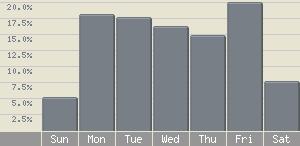
Distribution of visits during a week
Dibanding setahun lalu, relatif perubahan terjadi pada hari Senin sampai Rabu. Jika tahun lalu trafik tinggi hanya terjadi pada hari Kamis dan Jum'at sebagai persiapan kelas di hari Sabtu, untuk tahun ini, ada kecenderungan visit terjadi cukup merata dengan kisaran angka dari 18,1% di hari Senin sampai 14,9% di hari Kamis. Seperti biasa, hari Jum'at selalu menjadi hari favorit yang merepresentasikan "last check out".
Yang menarik, hari Sabtu yang setahun lalu tidak significant, tahun ini turut berkontribusi sebesar 7,8% disusul oleh hari Minggu di angka 5,2% yang sebelumnya 0%.
Page Views and Visits Chart

Meski demikian, trafik tahun 2006 yang diukur bulan ini sebagai sampling, relatif di drive oleh peningkatan pada minggu kedua November 2006 yang kemungkinan dipengaruhi issue Quiz semi UTS, seperti yang tampak pada tabel kedua.
Monday, November 06, 2006
041106 Class at a Glance (+ e-book of Dahan & Hauser)
Perkiraan kelar libur panjang akan dibahas tugas terkait “suara pelanggan” ternyata hasilnya mengecewakan, walhasil sessi minggu lalu “just an ordinary class” membahas materi dari bab-5 nya Dieter tentang “Concept Generation and Evaluation”.
Materi kuliah bisa di download di SINI.
Seperti yang sudah diinformasikan kemarin, minggu depan mohon dipersiapkan sessi Quiz yang mirip UTS. Bahan semua yang sudah di beri dari awal termasuk artikel di klasmaya ini.
Satu lagi terkait dengan materi Dahan and Hauser yang belum ngopy. Akhirnya alamat situsnya sempet ketemu (itu juga ga’ sengaja) di CIPD.
Ciao
Materi kuliah bisa di download di SINI.
Seperti yang sudah diinformasikan kemarin, minggu depan mohon dipersiapkan sessi Quiz yang mirip UTS. Bahan semua yang sudah di beri dari awal termasuk artikel di klasmaya ini.
Satu lagi terkait dengan materi Dahan and Hauser yang belum ngopy. Akhirnya alamat situsnya sempet ketemu (itu juga ga’ sengaja) di CIPD.
Ciao
Friday, November 03, 2006
Upload e-Book, part-1 Dieter Chap-13
Tadinya mau saya kasih judul Notes for next session 041006, tapi saya ragu untuk bisa dibahas besok, mungkin seperti rencana semula, pembahasan masih di materi Dahan Hauser yang sudah di share melalui salah satu flash disk partisipan.
Materi ini mungkin akan dibahas sekilas, toh menurut informasi, ada mata kuliah yang membahas konten ini secara khusus. Tapi karena terkait dengan evaluasi bisnis dalam Pengembangan Produk saya sengaja menyertakan file ini untuk disimak bersama. Aslinya satu file bab-13 ini berbobot kurang lebih 2 MB, untuk mempercepat akses saya bagi dua saja file tersebut. Bagian pertama bisa disimak di SINI.
Materi ini mungkin akan dibahas sekilas, toh menurut informasi, ada mata kuliah yang membahas konten ini secara khusus. Tapi karena terkait dengan evaluasi bisnis dalam Pengembangan Produk saya sengaja menyertakan file ini untuk disimak bersama. Aslinya satu file bab-13 ini berbobot kurang lebih 2 MB, untuk mempercepat akses saya bagi dua saja file tersebut. Bagian pertama bisa disimak di SINI.
Camp Samsung
Artikel Business Week ini cukup punya kaitan dengan materi Pengembangan Produk, khususnya untuk membayangkan bagaimana proses NPD di suatu perusahaan elektronik dunia.
To develop winning products, the Korean giant isolates artists and techies for months on end
By Moon Ihlwan
Business Week Online
JULY 3, 2006
Last June a group of 11 Samsung Electronics Co. employees pledged to do the last thing. most people desire just as spring bursts into summer: stay inside a drab room with small, curtained windows for the bulk of the next six weeks. The product planners, designers, programmers, and engineers had recently entered Samsung's so-called Value Innovation Program (VIP) Center, just south of Seoul. They were asked to outline the features and design of the company's mainstay flat-screen TV, code-named Bordeaux. And their bosses had vowed to keep them posted there until they had completed the assignment.
After an introductory ceremony attended by senior executives of Samsung's video division, the team joined a dozen or so similar groups at the VIP Center and got down to work. The facility is a sort of boiler room where people from across the company brainstorm day after day -- and often through the night. Guided by one of 50 "value innovation specialists," they study what rivals are offering, examine endless data on suppliers, components, and costs, and argue over designs and technologies. The Bordeaux team hammered out the basic look, feel, and features of the model by mid-August. Then over the next five months designers and engineers worked out the details, and by February the sets were rolling off Samsung assembly lines. They hit stores in the U.S. and South Korea this April, starting at about $1,300 for a 26-inch set. "For the first time in our company, we developed a TV appealing to customers' lifestyles," says Kim Min Suk, an official at Samsung's LCD TV Product Planning Group.
It's all part of a new mantra at Samsung: "market-driven change." In the past decade Samsung has radically improved the quality and design of its products. Yun Jong Yong, Samsung's 62-year-old chief executive, now wants the company to rival the likes of Microsoft Corp. (MSFT ) and IBM (IBM ) as a key shaper of information technology. By 2010 he aims to double sales, from $85 billion last year to $170 billion. The Korean giant, however, still isn't an innovation leader on the order of Apple Computer Inc. (AAPL ) or Sony Corp. (SNE ) in its heyday. Yun says Samsung has become "a good company," but "we still have a lot of things to do before we're a great company."
Yun insists that when it comes to manufacturing, his company is second to none. Yet in the Digital Age, when mechanical parts are replaced by chips, Samsung's well-run factories are no longer enough to make it stand out. He points to MP3 players as an example. Samsung rolled out its first players two years before Apple did. But Apple gave consumers the ultimate player -- the iPod -- and, with the iTunes software and Web site, an easy way to fill it with music. It's time for Samsung to start developing similar products, Yun says, that better serve customers. So far, "we don't have the power to deliver total solutions."
INCUBATION STAGE
How to make Samsung more innovative? One key initiative is the VIP Center. Yun set up the program in 1998 after concluding that as much as 80% of cost and quality is determined in the initial stages of product development. By bringing together everyone at the very beginning to thrash out differences, he believed, the company could streamline its operations and make better gadgets. In the past two years, though, the center's primary aim has shifted to "creating new value for customers," says Vice-President Lee Dong Jin, who heads the facility. Translation: Find that perfect balance of cost, innovation, and technology that makes a product great.
If it weren't such hard work, it might almost be fun. The center, at Suwon, Samsung's main manufacturing site, 20 miles from Seoul, is open 24 hours a day. Housed in a five-story former dormitory, it has 20 project rooms, 38 bedrooms for those who need to spend the night, a kitchen, a gym, traditional baths, and Ping-Pong and pool tables. Last year some 2,000 employees cycled through, completing 90 projects with names such as Rainbow, Rapido, and Rocky. Other products that have come out of the center include a notebook computer that doubles as a mobile TV, yet is thin and light enough to be carried in a handbag, and the CLP-500, a color laser printer that was built at the same cost as a black-and-white model. While some teams wrap up their work within weeks, other projects drag on for months, and all division leaders sign a pledge that participants won't return to their regular jobs until they have finished the project.
The Bordeaux team shows how the VIP Center works. The goal was to create a flat-screen TV that would sell at least 1 million units. But the team members quickly discovered that they had strongly differing opinions about what consumers want in a TV. The designers proposed a sleek, heavily sculpted model. Engineers wanted to pack in plenty of functions and the best picture and sound quality. Product planners were concerned primarily with creating something that would beat the offerings of Sharp Corp. (SHCAY ), then the leader in LCD TVs.
Every step of the way, team members drew what Samsung calls "value curves." These are graphs that rank various attributes such as picture quality and design on a scale of 1 to 5, from outright bad to excellent. The graphs compared the proposed model with those of rival products and Samsung's existing TVs. The VIP Center specialists also guided the team in discussions exploring ideas and concepts from entirely different industries, picking up hints about the importance of the emotional appeal in the offerings of furniture makers and Hollywood. "We wanted a curve resembling a wine glass, and a glossy back to make the TV fit in with other furniture," says designer Lee Seung Ho, who worked on the Bordeaux project.
One challenge the team faced: Surveys showed that shoppers buy a flat-screen TV as much for its look as a piece of furniture as for its technological muscle. Some members went to furniture stores to figure out what made buyers tick, and discovered that the design of the set trumps most other considerations. So the group started shedding function in favor of form, cutting corners on high-tech features to spend more to make a TV that looks good even when it's turned off. The control buttons were placed out of sight on the side, while the speakers were tucked under the screen to create a sleek, minimalist front underlined by a flat, curving V in blue or burgundy. The back and stand got the same high-gloss coating as the front. To keep costs down (part of that quest for value), Samsung removed a sensor that automatically adjusts the brightness to the light in the room and decided not to boost resolution to accommodate the latest high-definition standards. And with the speakers under the screen, the sound quality was lowered even as the TV's silhouette improved. "We tried to make sure consumers get maximum value for an affordable price," says Kim Dong Joon, one of several senior managers at the VIP center.
The initial response is encouraging. In the last week of May, Samsung inched ahead of Sony to become the No. 1 LCD TV brand in the U.S., garnering market share (in terms of value) of 26.4%, compared with Sony's 24.6% and Sharp's 8.2%, according to researcher NPD Group. In January, Samsung was No. 3, with just 12.1%. Yun now says he wants to become the top maker of digital TVs, including those using plasma and rear-projection technologies, in the U.S. this year.
Pretty grand ambitions. But Yun has a strong record of setting stretch goals and achieving them. Under hisstewardship, Samsung has transformed itself from an industry also-ran into the richest electronics maker in Asia. Now it could also become the coolest if Yun can reinvent Samsung one more time and get his engineers, designers, and marketers to dream up products such as the Bordeaux and really fire consumers' imaginations. It just might mean spending the summer inside.
To develop winning products, the Korean giant isolates artists and techies for months on end
By Moon Ihlwan
Business Week Online
JULY 3, 2006
Last June a group of 11 Samsung Electronics Co. employees pledged to do the last thing. most people desire just as spring bursts into summer: stay inside a drab room with small, curtained windows for the bulk of the next six weeks. The product planners, designers, programmers, and engineers had recently entered Samsung's so-called Value Innovation Program (VIP) Center, just south of Seoul. They were asked to outline the features and design of the company's mainstay flat-screen TV, code-named Bordeaux. And their bosses had vowed to keep them posted there until they had completed the assignment.
After an introductory ceremony attended by senior executives of Samsung's video division, the team joined a dozen or so similar groups at the VIP Center and got down to work. The facility is a sort of boiler room where people from across the company brainstorm day after day -- and often through the night. Guided by one of 50 "value innovation specialists," they study what rivals are offering, examine endless data on suppliers, components, and costs, and argue over designs and technologies. The Bordeaux team hammered out the basic look, feel, and features of the model by mid-August. Then over the next five months designers and engineers worked out the details, and by February the sets were rolling off Samsung assembly lines. They hit stores in the U.S. and South Korea this April, starting at about $1,300 for a 26-inch set. "For the first time in our company, we developed a TV appealing to customers' lifestyles," says Kim Min Suk, an official at Samsung's LCD TV Product Planning Group.
It's all part of a new mantra at Samsung: "market-driven change." In the past decade Samsung has radically improved the quality and design of its products. Yun Jong Yong, Samsung's 62-year-old chief executive, now wants the company to rival the likes of Microsoft Corp. (MSFT ) and IBM (IBM ) as a key shaper of information technology. By 2010 he aims to double sales, from $85 billion last year to $170 billion. The Korean giant, however, still isn't an innovation leader on the order of Apple Computer Inc. (AAPL ) or Sony Corp. (SNE ) in its heyday. Yun says Samsung has become "a good company," but "we still have a lot of things to do before we're a great company."
Yun insists that when it comes to manufacturing, his company is second to none. Yet in the Digital Age, when mechanical parts are replaced by chips, Samsung's well-run factories are no longer enough to make it stand out. He points to MP3 players as an example. Samsung rolled out its first players two years before Apple did. But Apple gave consumers the ultimate player -- the iPod -- and, with the iTunes software and Web site, an easy way to fill it with music. It's time for Samsung to start developing similar products, Yun says, that better serve customers. So far, "we don't have the power to deliver total solutions."
INCUBATION STAGE
How to make Samsung more innovative? One key initiative is the VIP Center. Yun set up the program in 1998 after concluding that as much as 80% of cost and quality is determined in the initial stages of product development. By bringing together everyone at the very beginning to thrash out differences, he believed, the company could streamline its operations and make better gadgets. In the past two years, though, the center's primary aim has shifted to "creating new value for customers," says Vice-President Lee Dong Jin, who heads the facility. Translation: Find that perfect balance of cost, innovation, and technology that makes a product great.
If it weren't such hard work, it might almost be fun. The center, at Suwon, Samsung's main manufacturing site, 20 miles from Seoul, is open 24 hours a day. Housed in a five-story former dormitory, it has 20 project rooms, 38 bedrooms for those who need to spend the night, a kitchen, a gym, traditional baths, and Ping-Pong and pool tables. Last year some 2,000 employees cycled through, completing 90 projects with names such as Rainbow, Rapido, and Rocky. Other products that have come out of the center include a notebook computer that doubles as a mobile TV, yet is thin and light enough to be carried in a handbag, and the CLP-500, a color laser printer that was built at the same cost as a black-and-white model. While some teams wrap up their work within weeks, other projects drag on for months, and all division leaders sign a pledge that participants won't return to their regular jobs until they have finished the project.
The Bordeaux team shows how the VIP Center works. The goal was to create a flat-screen TV that would sell at least 1 million units. But the team members quickly discovered that they had strongly differing opinions about what consumers want in a TV. The designers proposed a sleek, heavily sculpted model. Engineers wanted to pack in plenty of functions and the best picture and sound quality. Product planners were concerned primarily with creating something that would beat the offerings of Sharp Corp. (SHCAY ), then the leader in LCD TVs.
Every step of the way, team members drew what Samsung calls "value curves." These are graphs that rank various attributes such as picture quality and design on a scale of 1 to 5, from outright bad to excellent. The graphs compared the proposed model with those of rival products and Samsung's existing TVs. The VIP Center specialists also guided the team in discussions exploring ideas and concepts from entirely different industries, picking up hints about the importance of the emotional appeal in the offerings of furniture makers and Hollywood. "We wanted a curve resembling a wine glass, and a glossy back to make the TV fit in with other furniture," says designer Lee Seung Ho, who worked on the Bordeaux project.
One challenge the team faced: Surveys showed that shoppers buy a flat-screen TV as much for its look as a piece of furniture as for its technological muscle. Some members went to furniture stores to figure out what made buyers tick, and discovered that the design of the set trumps most other considerations. So the group started shedding function in favor of form, cutting corners on high-tech features to spend more to make a TV that looks good even when it's turned off. The control buttons were placed out of sight on the side, while the speakers were tucked under the screen to create a sleek, minimalist front underlined by a flat, curving V in blue or burgundy. The back and stand got the same high-gloss coating as the front. To keep costs down (part of that quest for value), Samsung removed a sensor that automatically adjusts the brightness to the light in the room and decided not to boost resolution to accommodate the latest high-definition standards. And with the speakers under the screen, the sound quality was lowered even as the TV's silhouette improved. "We tried to make sure consumers get maximum value for an affordable price," says Kim Dong Joon, one of several senior managers at the VIP center.
The initial response is encouraging. In the last week of May, Samsung inched ahead of Sony to become the No. 1 LCD TV brand in the U.S., garnering market share (in terms of value) of 26.4%, compared with Sony's 24.6% and Sharp's 8.2%, according to researcher NPD Group. In January, Samsung was No. 3, with just 12.1%. Yun now says he wants to become the top maker of digital TVs, including those using plasma and rear-projection technologies, in the U.S. this year.
Pretty grand ambitions. But Yun has a strong record of setting stretch goals and achieving them. Under hisstewardship, Samsung has transformed itself from an industry also-ran into the richest electronics maker in Asia. Now it could also become the coolest if Yun can reinvent Samsung one more time and get his engineers, designers, and marketers to dream up products such as the Bordeaux and really fire consumers' imaginations. It just might mean spending the summer inside.
Wednesday, November 01, 2006
WiFi Gadget-nya Sony, sebuah perbandingan
Selepas presentation day sessi-1 saya pernah mengulas tentang gadget assignment dengan apa yang sedang di develop oleh perusahaan elektronik raksasa Sony. Untung artikel ini masih kesimpan di HD saya yang ada bagusnya disajikan disini sebagai perbandingan dengan apa yang sudah dipaparkan tempo hari lalu.
Sekilas tidak banyak berbeda dengan apa yang kalian bayangkan, ada fitur Instant Messaging Internet browser, atau media player dan storage-nya, meski fitur VoIP yang jadi salah satu andalan malah kelewat. Tapi yang menarik, fitur game yang dominan dibenak partisipan justru malah tidak muncul dalam produk ini.
Sony To Launch a New Kind of Wireless Handheld for IM, Other Internet-Based Communications
By Associated Press

SAN FRANCISCO (AP) -- Hoping to tap into the growth of wireless networks across college campuses, other public spaces and within homes, Sony Corp. will announce Tuesday a new pocket-sized gadget for instant messaging and other Internet-based communications.
The Sony mylo, slated for availability in September at a retail price of about $350 (euro270), is a first-of-its-kind product that uses Wi-Fi networks, analysts say. It is not a cellular phone and thus does not carry monthly service fees. And though it could handle Web-based e-mail services, it does not support corporate e-mail programs.
Instead, the slim, oblong-shaped gizmo that has a 2.4-inch (6-centimeter) display and slides open to expose a thumb keyboard is specifically geared toward young, mainstream consumers for messaging and Internet-based calls, commonly known as VoIP (Voice over Internet Protocol) calls.
As long as a Wi-Fi network is accessible, a mylo user could chat away or browse the Web.
The mylo -- which stands for ''my life online,'' -- will be marketed toward 18- to 24-year-olds, the multitasking generation that relies heavily on instant messaging and is already viewing e-mail as passe, Sony said.
The consumer electronics giant has partnered with Yahoo Inc. and Google Inc. to integrate their instant-messaging services, and is looking to expand mylo's support to other services as well, most notably the leading messaging provider, Time Warner Inc.'s America Online.
Sony has also teamed with eBay Inc.'s Skype VoIP service, which offers free voice chats for its registered users.
The so-called personal communicator doubles as a portable media player. It can play music, photos and videos that are stored on its internal 1 gigabyte of flash memory or optional Memory Stick card. It also can stream songs between mylo users within the same network, as long as the users grant permission to share their music files.

Sony is betting that mylo will draw great interest not just among college students but also among households where youngsters might be fighting over the use of a computer just for chatting or Web surfing.
''Our mylo personal communicator lets you have the fun parts of a computer in the palm of your hand,'' said John Kodera, a director of product marketing at Sony.
Sekilas tidak banyak berbeda dengan apa yang kalian bayangkan, ada fitur Instant Messaging Internet browser, atau media player dan storage-nya, meski fitur VoIP yang jadi salah satu andalan malah kelewat. Tapi yang menarik, fitur game yang dominan dibenak partisipan justru malah tidak muncul dalam produk ini.
Sony To Launch a New Kind of Wireless Handheld for IM, Other Internet-Based Communications
By Associated Press

SAN FRANCISCO (AP) -- Hoping to tap into the growth of wireless networks across college campuses, other public spaces and within homes, Sony Corp. will announce Tuesday a new pocket-sized gadget for instant messaging and other Internet-based communications.
The Sony mylo, slated for availability in September at a retail price of about $350 (euro270), is a first-of-its-kind product that uses Wi-Fi networks, analysts say. It is not a cellular phone and thus does not carry monthly service fees. And though it could handle Web-based e-mail services, it does not support corporate e-mail programs.
Instead, the slim, oblong-shaped gizmo that has a 2.4-inch (6-centimeter) display and slides open to expose a thumb keyboard is specifically geared toward young, mainstream consumers for messaging and Internet-based calls, commonly known as VoIP (Voice over Internet Protocol) calls.
As long as a Wi-Fi network is accessible, a mylo user could chat away or browse the Web.
The mylo -- which stands for ''my life online,'' -- will be marketed toward 18- to 24-year-olds, the multitasking generation that relies heavily on instant messaging and is already viewing e-mail as passe, Sony said.
The consumer electronics giant has partnered with Yahoo Inc. and Google Inc. to integrate their instant-messaging services, and is looking to expand mylo's support to other services as well, most notably the leading messaging provider, Time Warner Inc.'s America Online.
Sony has also teamed with eBay Inc.'s Skype VoIP service, which offers free voice chats for its registered users.
The so-called personal communicator doubles as a portable media player. It can play music, photos and videos that are stored on its internal 1 gigabyte of flash memory or optional Memory Stick card. It also can stream songs between mylo users within the same network, as long as the users grant permission to share their music files.

Sony is betting that mylo will draw great interest not just among college students but also among households where youngsters might be fighting over the use of a computer just for chatting or Web surfing.
''Our mylo personal communicator lets you have the fun parts of a computer in the palm of your hand,'' said John Kodera, a director of product marketing at Sony.

Subscribe to:
Posts (Atom)