Monday, March 23, 2015

Rakuten .. again


------------------------------------------------------------------------------------------------------------------------

August 12, 2014, by Allison Enright 

The Japanese e-commerce company previously invested in the Silicon Valley startup.

Rakuten Inc. has acquired Slice, a shopping application that helps consumers keep track of their online shopping.

Terms of the buy were not disclosed. Rakuten, a Japanese company that operates online marketplace sites around the globe and has made numerous e-commerce investments in recent years, first invested in Slice last year, leading a $23 million funding round.

Slice’s shopping app, launched in 2011, organizes the order confirmations and shipping notifications that e-retailers e-mail to consumers after they purchase. Consumers let the Slice application access their webmail accounts.

“We couldn’t have found a better partner as we grow our business and product portfolio,” writes Slice founder and CEO Scott Brady in a blog post announcing the purchase. “Joining forces with Rakuten now enables us to exponentially increase our ability to develop the technology and products to bring that transformative vision to life more quickly and at a scale beyond what we could achieve independently.” Brady goes on to say Slice will operate as a stand-alone business and retain current management.

Rakuten had no immediate comment on why it purchased Slice or what it intends to do with it.

-------------------------------------------------------------------------------------------------------------------------

June 30, 2014 by Don Davis

The company plans to invest in early-stage companies based in Asia, the United States and Israel.

Like many successful Japanese companies, Rakuten Inc. has taken profits from its operations in Japan to expand globally. That continued today with the Tokyo-based company announcing plans to create a $100 million fund to invest in young technology companies that have a focus on improving user experience.

Rakuten Ventures, the investment are of Rakuten Inc., said today the new fund will focus on investing in technology start-ups in Israel, the Asia-Pacific region and the United States. It will be based in Singapore and run by Saemin Ahn, managing partner of Rakuten Ventures. Rakuten Ventures set up a similar fund last year to invest in companies in Southeast Asia.

Rakuten, whose Rakuten Ichiba marketplace is the leading e-commerce site in Japan, has invested billions in recent years in e-commerce and online marketing companies in North and South America, Asia and Europe. The company’s global e-retail sites and shopping portals accounted for $18 billion in sales in 2013, while the company reported revenue grew 29.5% to $4.9 billion and net income more than doubled to $412.6 million.

In a statement announcing the new fund, Saemin Ahn, pointed to two companies with roots in Israel as examples of the kind of start-ups that have rapidly won consumer loyalty: Waze, a mobile travel app developer that Google Inc. acquired last year, and messaging service provider Viber Media Inc., which Rakuten acquired in February for $900 million.

“More Asia-based VCs are venturing out into different regions to look at investment as long-term growth vehicles,” he said. “Since 2013, Rakuten Ventures has been one of such VCs to aggressively invest larger amounts into younger companies, to enable them to focus on product and service development.”

Rakuten chairman and CEO Hiroshi Mikitani has made clear his global ambitions: He said last year aims to operate marketplaces in 27 countries and process $125 billion in transactions by 2020. By contrast, eBay Inc. reported the total value of transactions on its shopping portals in 2013 was $77 billion, and Internet Retailer estimates Amazon.com Inc.’s sales on its worldwide sites last year amounted to $100 billion.

To achieve that growth, Rakuten has been on a buying spree in recent years.

The company in 2010 acquired U.S. e-retailer Buy.com for $250 million, renaming it Rakuten Shopping and turning it into a marketplace that hosts other merchant’s products but does not sell on its own behalf. Other investments include purchasing a stake in image-based social network Pinterest in 2012, buying e-reader company Kobo in 2011 for $315 million, and taking a stake in U.S. e-retailer The Grommet Inc., No. 415 in the 2014 Internet Retailer Top 500 Guide. In 2005, Rakuten acquired affiliate marketing network Linkshare for $425 million.

Rakuten’s European investments include: acquiring French online shopping mall Price Minister in 2010 for $248 million; taking an 80% stake in 2011 in Germany web marketplace operator Tradoria GmbH; buying U.K. e-retailer Play.com in 2011 for $39 million and participating in a $100 million investment round in 2011 in Russian online retailer Ozon.ru. Play.com is No. 28 in the 2014 Internet Retailer Europe 500 and Ozon.ru is No. 89.

Europe smart meters projection

From Berg Insight 's report 
December 2014


According to a new report from the research firm Berg Insight, 40 percent of all gas customers in Europe will have smart gas meters by 2020. At the end of 2014, there were 2.5 million smart gas meters in the EU28+2 area, corresponding to a penetration rate of around 2 percent. By 2020, the installed base is projected to reach 49.0 million units. The increase will mainly be driven by nationwide rollouts in France, Italy, the Netherlands and the UK. In early 2015, the Netherlands will become the first European country to reach 1 million units installed as the Dutch utilities start the mass-deployment of smart meters. At the end of the year, Berg Insight also expects that massive installations will get underway in Italy and France. Earlier this year, the French national gas distribution network operator GrDF placed orders for a total of 11 million smart gas meters that will be deployed until 2020. GrDF and several leading gas network operators in Italy intend to use 169 MHz radio technology as the communication platform for their solutions, while smart electricity meters will be used as local communication hubs in the UK and the Netherlands. 

While the smart gas meter rollouts are largely proceeding according to plan in the countries mentioned, the UK is facing a more difficult situation. Following the announcement that the country’s centralised data and communications system will not become operational before the end of 2016, Berg Insight expects that the mass-rollout of smart meters will not begin before 2017. As a consequence of the delay, the official target that the rollout should be completed by 2020 seems unattainable. “We are fully convinced that the UK smart metering project will eventually come to its conclusion, but the multitude of challenges arising from such a complex undertaking require considerable time to resolve” says Tobias Ryberg, Senior Analyst, Berg Insight and author of the report. “If there is one thing that can be learned from a decade of smart metering projects in Europe, it is that they get delayed.” 

70 percent of Europe's electricity customers will have smart meters by 2022

At the end of 2014, there were 67.9 million smart electricity meters in the EU28+2 area, corresponding to a penetration rate of 24 percent. By 2022, the installed base is projected to reach 199.7 million units. The vast majority of Europe’s smart electricity meters are today deployed in Italy, Spain and the Nordic countries. Over the coming 6–8 years, nationwide rollouts are planned in a number of additional countries in Western Europe, including France, the UK, the Netherlands, Austria and Ireland. Moreover, Berg Insight expects a significant uptake in several countries in Eastern Europe such as Poland, Bulgaria, Slovakia and Estonia. The outlook for Germany is however less optimistic as several regulatory and technical issues still need to be resolved. 

Berg Insight expects that the European smart electricity market will perform well in the coming years as a number of new and ongoing rollouts ramp up to full speed. During 2015, shipments of smart electricity meters are expected to grow by 30 percent to 8.4 million units, fuelled by new and expanded projects in France, the Netherlands and Norway. By 2017, Berg Insight also expects that the much delayed rollout in the UK will finally get up to speed. “Based on the current time plans and projections, the European smart meter market will peak at 25–30 million units per year in the early 2020s”, says Tobias Ryberg, Senior Analyst, Berg Insight. “Besides greenfield deployments, we also expect to see next generation upgrades of the oldest existing systems in countries such as Italy“. 

Saturday, March 21, 2015

Rakuten Corporate Action

OverDrive       $410 million : will April 2015 ? e-book distributor
Lyft Inc            $530 million
Ebates Inc        $981 million : October 2014
Viber Media    $905 (or $900?) million : March 2014mobile chat and app platform provider
Wuaki.tv
Viki Inc
Kobo Inc.         $350 (or $315?) million : ? 2012 : e-reader and e-book provider
Play.com          $39 million : 2011 : U.K. e-commerce operator
Ikeda                75% stake : June 2011: e-commerce technology and services
Tradoria          80% stake : 2011: e-commerce platform
PriceMinister  $248 million : 2010 : France-based e-commerce operator
Buy.com           $250 million: 2010 : e-retailer

Total                 $3.2 billion

-------------------------------------------------------------------------------------------------------------------------

From internetretailer.com 's article
Rakuten pays $410 million for U.S. e-book marketplace OverDrive

March 19, 2015 by BLOOMBERG NEWS


OverDrive will strengthen Rakuten’s e-book business by adding a distribution platform, more than 2.5 million titles, relationships with 5,000 publishers and 30,000 libraries.


(Bloomberg) -- Rakuten Inc., operator of Japan’s biggest Internet shopping mall, will pay $410 million in cash for e-book distributor OverDrive Inc. to expand its digital content business.

OverDrive will strengthen Rakuten’s e-book business by adding a distribution platform, more than 2.5 million titles, relationships with 5,000 publishers and 30,000 libraries.

Rakuten has spent about $3.2 billion over the past three years to buy companies as it expands into online services and selling e-books, video and other content. The company said earlier this month it would invest $530 million into Lyft Inc. and paid $981 million in cash for Ebates Inc. in October, after acquiring Viber Media Ltd. last March for $905 million.

Rakuten’s billionaire chairman Hiroshi Mikitani has introduced tablets in Japan to help sell e-books, tracking rival Amazon.com Inc.’s strategy of delivering digital content through its Kindle platform. Mikitani is Japan’s third-richest man with a net worth of about $9.8 billion according to the Bloomberg Billionaires Index.

OverDrive supplies the industry’s largest catalog of e- books, audiobooks, music and streaming video to 33,000 libraries, schools and retailers worldwide. It will operate as a subsidiary of Rakuten’s U.S. unit.

As of Dec. 31, Rakuten had about $9.9 billion in net cash, according to Bloomberg.

Rakuten.com Shopping is No. 46 in the Internet Retailer 2014 Top 500 Guide, while Rakuten Inc. is No. 20 (2?) in the Internet Retailer 2015 Asia 500. Amazon.com is No. 1 in the Top 500.

-------------------------------------------------------------------------------------------------------------------------

Japan’s Rakuten buys U.S. rebate site Ebates for $1 billion
September 9, 2014 by BLOOMBERG NEWS

It represents another step toward expansion into the U.S. for the company that previously bought Buy.com and other e-retail assets.

Sept. 9 (Bloomberg) -- Rakuten Inc. agreed to buy U.S. rebates web site Ebates Inc. in Japan’s largest e-commerce deal as the operator of the country’s biggest online mall seeks expansion outside its home market through acquisitions.

Rakuten will pay $1 billion in cash for all of Ebates, it said in a filing to the Tokyo Stock Exchange yesterday. San Francisco-based Ebates offers cash rebates to customers who buy products ranging from laptops to lipsticks from the web site’s retail partners.

Rakuten is betting the purchase will help push its global e-commerce strategy. Rakuten has also been plowing cash into technologies such as mobile applications and online video as it seeks to add to its online marketplace business.

“This deal doesn’t just mean we’ve started a cash-back web site in the U.S., I think we can operate this model all over the world,” Mikitani told reporters at a briefing in Tokyo yesterday. The purchase will lift the proportion of Rakuten’s e- commerce transactions from outside Japan to 16% from about 6% currently, he said.

Rakuten targets to raise the proportion to 50% of total around 2020, said Mikitani, Japan’s fourth-richest man with a net worth of about $7 billion according to the Bloomberg Billionaires Index.

Points Program

Rakuten fell 1.3% to 1,254 yen in Tokyo yesterday, the lowest level since May 23. The stock has lost 20% this year, compared with the 0.2% decline in the benchmark Topix index. The shares dropped the most in three months on Sept. 8 on concerns about the deal’s cost effectiveness, after Rakuten confirmed it was in negotiations.

The company wants to create with Ebates a membership-based marketplace with “the world’s largest product line-up” ranging from niche to luxury items, and featuring a points program, Rakuten said in the exchange statement. The potential impact on its earnings from the acquisition is “difficult to estimate” at present, it said.

Ebates, which has 2.5 million active members and more than 2,600 retailers in its network, posted an operating income of $13.7 million on net revenue of $167.4 million in fiscal 2013, Rakuten said. Members spent $2.2 billion shopping through Ebates last year.

“Joining forces with Rakuten will help accelerate our U.S. and international growth,” Kevin Johnson, chief executive officer of Ebates, said in a Rakuten statement distributed by Businesswire.

Viber Purchase

The deal comes after Rakuten announced 18 acquisitions since the start of last year, and the cybermall operator said in June it’s open to more large-scale buys following its bond debut. Rakuten bought messaging service Viber Media Inc. for $905 million in March, Japan’s biggest e-commerce deal at the time according to data compiled by Bloomberg.

The company, which Mikitani founded in 1997, was an acquirer in three of the top ten e-commerce deals in Japan before the Ebates purchase was announced, according to data compiled by Bloomberg. As of June 30, Rakuten had about 1.7 trillion yen ($16 billion) in cash and short-term investments, according to data compiled by Bloomberg.

-------------------------------------------------------------------------------------------------------------------------

Rakuten buys mobile messaging company Viber for $900 million
February 14, 2014 by AMY DUSTO Associate Editor

Viber allows members to chat and talk for free on mobile, as well as purchase and send each other digital stickers. Rakuten’s CEO says it has “tremendous potential” to become a gaming platform, too.

Rakuten Inc. has purchased mobile chat and app platform provider Viber Media Inc. for $900 million, the retailer announced today. Viber provides free chat and voice-over- Internet (VoIP) services to consumers. It also allows users to purchase and send digital versions of cartoon-like stickers, similar to emoticons in chat messages, to one another. Additionally, Viber has “tremendous potential” as a mobile gaming platform.

Viber understands how people actually want to engage, this makes Viber the ideal total consumer engagement platform for Rakuten to bring deep understanding to vast new audiences. 

Viber grew its user base by 120% in 2013, to 300 million. Viber will gain access to markets in which it does not currently have strong penetration, while Rakuten will benefit by gaining access to over 277 million new prospective Rakuten users in markets where Viber has an established presence, such as Western Europe.

Rakuten operates the largest online shopping portal in Japan and is the No. 2 e-retailer in all of Asia by sales according to the Internet Retailer’s Asia 500. The company acquired U.S. online discount retailer Buy.com in 2010. It later renamed the retailer Rakuten Shopping and converted it into an online marketplace that hosts other merchants’ shops but does not sell on its own behalf, in the model of Rakuten Japan.

Rakuten has been building out its digital services over the last two years, starting with its acquisition of e-reader and e-book provider Kobo Inc. for $350 million in 2012. Since then, it has also bought two streaming video services, Spanish Wuaki.tv and Palo Alto-based Viki Inc. Today, Rakuten offers 40 Internet services associated with its Rakuten Super Points rewards program, which has roughly 225 million members worldwide. With Viber, the retailer will bring many of those services together onto one platform with single login for members. The acquisition also illustrates a fundamental shift in Rakuten’s strategic direction, which is mobile-first.


-------------------------------------------------------------------------------------------------------------------------

November 8, 2011 by MARK BROHAN Research Director

The value of the all-cash deal is $315 million.

Japan-based Rakuten Inc. keeps on buying up companies it believes will transform it into a global online retailer powerhouse.

This time the merchandising category is the lucrative electronic books and digital content market and the acquisition is Kobo Inc., the e-book reader maker and content  provider that’s also a unit of Toronto-based retailer Indigo Books & Music No. 177 in the Internet Retailer Top 500 Guide.

Rakuten, which acquired U.S. e-retailer Buy.com in 2010 will acquire Kobo for $315 million in cash.

Kobo provides one of the world’s most communal e-book reading experiences with its innovative integration of social media, such as Facebook and Twitter; while Rakuten offers Kobo unparalleled opportunities to extend its reach through some of the world’s largest regional e-commerce companies.

Kobo, which in July launched its first overseas venture in Germany, agreed to be acquired because a bigger organization could help Kobo diversify and grow quicker against bigger rivals such as Barnes & Noble, which makes and markets the Nook e-reader, and Amazon.com, which develops and sells the Kindle e-reader.

Kobo is the most social eBook service on the market and one of the world’s largest eBook stores with over 2.5 million titles. This transaction will greatly strengthen position in current markets and allow to diversify quickly into other countries and e-commerce categories.

Kobo was increasingly an also-ran in the U.S. e-book reader market with only 6% market share in April 2011, according to a survey by e-commerce software firm Elastic Path reported by research firm eMarketer. But Kobo commanded 36% of the market in its home country of Canada in August 2011, according to a survey by market research firm Ipsos.


-------------------------------------------------------------------------------------------------------------------------

Japan’s Rakuten to buy U.K.-based online retailer Play.com
September 21, 2011 by Thad Rueter

The acquisition marks the latest global e-commerce investment for the owner of Buy.com

Japan-based Rakuten Inc. today said it will buy U.K. e-commerce operator Play.com for 25 million pounds (US$39 million).

The acquisition of the retailer, which sells music, DVDs, books, consumer electronics, office equipment, mobile phones, toys and other products, marks the latest global e-commerce investment by Rakuten, which in 2010 bought U.S. e-retailer Buy.com Inc.

Play.com, No. 26 in the Internet Retailer Europe 300 Guide, had online sales of $660 million last year, up 18% from the year before.  Buy.com is No. 32 in the Internet Retailer Top 500 Guide.

“The U.K. market is one of Europe’s largest and most mature e-commerce markets. Play.com is not only a pioneer in the market, but also one of the U.K.’s most successful e-commerce businesses,” says Hiroshi Mikitani, chairman and CEO of the Japan-based e-marketplace operator. “We aim to leverage our e-commerce strength and experience to further expand and develop Play.com’s business model and channel its loyal user base, merchants, and deep product offerings into Rakuten’s global e-commerce network.”

Rakuten says it will buy up all of Play.com’s stock.

Earlier this month, Rakuten was part of a group of investors that raised $100 million for Russia-based online retailer Ozon.ru, which, like Play.com, sells a wide variety of products.  The investment followed Rakuten’s purchases in June of a 75% stake in Brazil-based Ikeda, which sells e-commerce technology and services to more than 100 of the largest online retailers in that country. Rakuten this year also acquired 80% of Germany-based Tradoria GmbH, which sells an e-commerce platform. In 2010, Rakuten bought France-based e-commerce operator PriceMinister.

Thursday, March 19, 2015

Asia Pacific (excl Japan) Online Game Market Projection

Taken from enterpriseinnovation.net 's article

Online gaming in APAC to breach $30B in 4 years


The online gaming revenue in the Asia Pacific excluding Japan (APEJ) is expected reach $30.39 billion in 2018 at a CAGR of 18.53%, according to IDC.

This growth comes despite a slowdown in Southeast Asian markets in 2013 as service providers prepared to include mobile games into their business strategies and game portfolios. 

Online gaming revenue in APEJ was $12.96 billion in 2013 with growth of 14.27% over $11.34 billion in 2012. IDC said that the number of online gaming users will rise to 335.88 million in 2018, from 240.74 million in 2013.

What is most encouraging is a corresponding rise in the number of paying online gamers, from 102.81 million in 2013 to nearly 150 million in 2018.

“Online gaming in the APEJ region is not only a fast growing segment but it is also poised to take advantage of the wave of consumer smartphone adoption to access the mobile internet across the region,” says Shiv Putcha, associate research director for consumer mobility at IDC Asia Pacific. 

Putcha said that the first major driver comes down to strong regional growth. China has been and will continue to be the dominant force in online gaming but other markets, like Korea and Taiwan, are also seeing strong growth. The top three markets — China, Korea, and Taiwan — make up 95.56% of online gaming revenue in APEJ.

On the other hand, emerging markets, like India and Indonesia, have nascent online gaming markets but have made great strides in the last year, he observes

"The higher penetration of internet, broadband, PC, and mobile device and completely free-to-play (F2P) game offerings increased the popularity of mobile games,” said Putcha.

“eSports and competitive games such as MOBA games continue to attract online PC gamers,” added Putcha. “The popularity of competitive games, such as e
Sports and mobile battle arena games, continue to attract online PC gamers in Asia Pacific."

Putcha notes that the online gaming market has completely transitioned from a subscription fee–based business model into a freemium model.

Sunday, March 15, 2015

Success recipe

Take  from Business Insider

50 Universal Truths That Will Make You More Successful
by JULIE BORT OCT. 28, 2013

No matter what is going on in your career, good advice is universal. No matter what problems you are trying to solve, chances are someone else before you had a similar problem.

There are certain universal "business truths" — tips and tricks that work for nearly everyone in every business. They are:

1. Have a passion for your work. If your work is meaningful to you, your work life will be a joy.

2. If you can't be passiona7te about the work itself, be passionate about the reason you do it. Maybe you don't love your job or company or career, but the money and benefits are good for your family. Be passionate in your choice to do right by your family.

3. If something needs changing, be the one to lead the change. If you dislike your job but are stuck, work on getting the skills that will get you unstuck. If there's a problem at your office, work on being the one solve it.

4. Start small and build from there.

5. Do the obvious stuff first, then progress to the harder stuff. (Otherwise known as going for the low-hanging fruit.)

6. If it's not broke, don't fix it. Do improve it.

7. The hardest lesson to learn is when to keep going and when to quit. No one can teach you that. At some point, you have to choose.

8. The definition of crazy is to do the same thing the same way and expect a different result. If the result isn't good, change something.

9. No one succeeds alone.

10. Ask for help. Be specific when asking. Be graceful and grateful when help comes.

11. Surround yourself with positive people and you'll have a positive outcome.

12. Embrace diversity. The best way to compensate for your own weaknesses is to pick teammates who have different strengths.

13. People experience the world differently. Two people can attend the same meeting and walk away with different impressions. Don't fight that. Use it.

14. You don't have to like someone to treat that person with respect and courtesy.

15. Don't "should" all over someone, and don't let someone else "should" all over you.

16. No matter what you do or how much you achieve, there are always people who have more.

17. There will always people who have less, too.

18. No matter how much you excel at things, you are not a more worthwhile human being than anyone else. No one else is more worthwhile than you, either.

19. If you spend most of your time using your talents and doing things you are good at, you're more likely to be happy.

20. If you spend most of your time struggling to improve your weaknesses, you're likely to be frustrated.

21. Practice is the only true way to master a new skill. Be patient with yourself while you learn something new.

22. The only way to stay fresh is to keep learning new things.

23. To learn new things means being a beginner, and that means making mistakes.

24. The more comfortable you grow with making beginner mistakes, the easier it is to learn new things.

25. You will never have all the resources (time, money, people, etc.) that you want for your project or company. No one ever has all the resources they want.

26. A lack of resources isn't an excuse. It's a blessing in disguise. You'll have to get creative.

27. Creativity and innovation are skills that can be learned and practiced by doing your usual things in a new way.

28. Take calculated risks.

29. In the early stages of a company, career, or project, you'll have to say "yes" to a lot of things. In the later stages, you'll have to say "no."

30. Negative feedback is necessary. Don't automatically reject it. Examine it for the nuggets of truth, and then disregard the rest.

31. When delivering criticism, talk about the work, not the person.

32. Think big. Dream big. (The alternative is to think small, dream small.)

33. Treat your dream as an ultimate roadmap. You don't have to achieve your dream right away, but the only way to get there is to take many steps toward it.

34. If you think big, you will hear "no" more than you hear "yes." They don't get to decide. You do.

35. How long it takes you to create something is less important than how valuable and worthwhile it will be once it's created.

36. If there is one secret to success, it's this: communicate your plans with other people and keep communicating those plans.

37. Grow your network. Make an effort to meet new people and to keep in contact with those you know.

38. No matter what technology or service you are creating or inventing at your company, it's not about the product; it's always about the people and the lives you will improve.

39. No matter how successful you get, you can still fail and fail big.

40. Failure isn't a bad thing. It's part of the process.

41. Things always go wrong. The only way to keep that from hurting you is to plan for that.

42. Learn how to respectfully, but firmly, say "no."

43. Say "yes" as much as you can.

44. In order to say "yes" often, attach boundaries or a scope of work around your "yes."

45. No matter how rich, famous, or successful another person is, inside that person is just a human being with hopes, dreams, and fears, the same as you.

46. Getting what you want doesn't mean you'll be happy. Happiness is the art of being satisfied with what you already have.

47. Working with difficult personalities will be a part of every job. Be respectful, do your job well, and nine times out of 10 that person will move on.

48. For that one-out-of-10 time, remember you aren't a victim. Do what you need to get a new job.

49. As soon as you have something to demonstrate, get an executive champion to back or support your project.

50. Focus on what you want, not what you don't want.

Why it is called "cloud"

Taken from BusinessInsider 's article
Why ‘cloud computing’ is called ‘cloud computing’
by MATT WEINBERGER

Rewind to the early nineties: Computer scientists and engineers needed some way in their diagrams and slideshows to refer to “the network,” that big grouping of computers and storage devices out there somewhere. In other words, they needed some way to refer to something that was, essentially, somebody else’s problem.

They settled on a cloud.

You can see one of the earliest uses of that idea in this diagram from US Patent 5,485,455, “Network having secure fast packet switching and guaranteed quality of service,” filed in the January of 1994.

If you squint, that “Network” bubble is cloud-like. The patent’s authors just meant to illustrate that what was in the network wasn’t important for their purposes.

By the time US Patent 5,790,548, “Universal access multimedia data network,” was filed for in the April of 1996, the cloud looked a lot more like a cloud:

It’s just meant to be a vague description of things happening elsewhere.

This usage led to the growing popularity of the term “cloud computing” to refer to servers, networks, and data centers that were located or managed elsewhere and thusly someone else’s problem. A Compaq document from 1996 was probably the first time the term was used in any kind of official capacity, reports the Technology Review. But the term really caught on when Amazon Web Services launched its Elastic Compute Cloud (EC2) in 2006.

Amazon EC2 basically sells virtual servers to other companies — the very definition of “somebody else’s problem.” Other companies caught on and started offering software (like Salesforce), storage (like Box), or a mix of the two (like Microsoft Office 365) from their own data centers to companies who don’t really care where it comes from. To them, the cloud providers are their own squiggly lines on a diagram.

Thursday, March 12, 2015

What is Programmatic Advertising

Taken from digiday.com 's article
WTF is programmatic advertising?


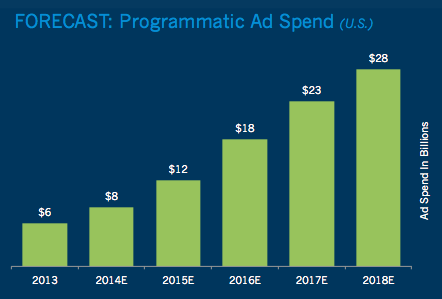
Klasmaya additional figure
Source: BI Intelligence estimates, Magna Global, IDC


Programmatic ad buying has changed the face of online advertising, but there’s still confusion around what it actually is. Here’s a primer, in plain English:

What is programmatic ad buying?
“Programmatic” ad buying typically refers to the use of software to purchase digital advertising, as opposed to the traditional process that involves RFPs, human negotiations and manual insertion orders. It’s using machines to buy ads, basically.

Why does programmatic advertising matter?
Efficiency. Before programmatic ad buying, digital ads were bought and sold by human ad buyers and salespeople, which are expensive and unreliable. Programmatic advertising technology promises to make the ad buying system more efficient, and therefore cheaper, by removing humans from the process wherever possible. Humans get sick, need to sleep and come to work hungover. Machines do not.

So robots are replacing people? Great.
Yes and no. Technology is being used to replace some of the more menial tasks that humans have historically had to deal with, like sending insertion orders to publishers and dealing with ad tags, but they’re still required to optimize campaigns and to plan strategies. Programmatic technology will probably mean there are fewer ad buyers in the world, but it could also allow both marketers and sellers to spend more of their time planning sophisticated, customized campaigns instead of getting bogged down in bureaucracy.

Is programmatic buying is the same as real-time bidding, then?
No, it’s not. Real-time bidding is a type of programmatic ad buying, but it isn’t the only one. RTB refers to the purchase of ads through real-time auctions, but programmatic software also allows advertisers to buy guaranteed ad impressions in advance from specific publisher sites. This method of buying is often referred to as “programmatic direct.”

Is programmatic “the future of ad buying”?
Probably, yes. It’s impossible to tell what portion of advertising is now traded programatically, but it’s definitely on the rise. Some agencies now say they’re eager to buy as much media as possible through programmatic channels, and some major brands have even built out in-house teams to handle their programmatic ad buying as they spend more of their marketing budgets that way. At the moment, it’s mainly online ads that are traded programatically, but increasingly media companies and agencies are exploring ways to sell “traditional” media this way, including TV spots and out-of-home ads.

Wednesday, March 11, 2015

Telecom's e-commerce in Indonesia

Taken from The Jakarta Post's article

Telcom firms build up e-commerce outlets

Driven by a huge market potential and hundreds of millions of Internet users in the country, domestic telecommunications operators are getting more serious about developing their e-commerce businesses.

Three major telecommunication operators PT Telekomunikasi Indonesia (Telkom), PT XL Axiata and PT Indosat have allocated some amount of investment this year to revamp their e-commerce businesses.

XL

Through its financial report, XL disclosed that on Jan. 27, it poured US$12.1 million into Elevenia (www. elevenia.co.id), its e-commerce outlet. That investment was equal to the amount invested in the marketplace by its partner SK Planet, a subsidiary of South Korean SK Telecom.

"The additional investment was part of Elevenia's blueprint that has been agreed upon by both XL and SK Planet," said Elevenia chief financial officer Lila Nirmandari.

Both business partners open the possibility of adding more fresh capital to the marketplace in the coming months, depending on the market dynamic, she told The Jakarta Post.

Lila said most of the $24.2 million investment would be used to support sales and promotion activities to make Elevenia known better outside Greater Jakarta.

Officially launched in March last year, Elevenia was first established in mid-2013 with initial investments of $18.3 million from XL and another $18.3 million from SK Planet, giving each of them a 50 percent of stake.

As of February, Elevenia had around 20,000 merchants and 2 million products comprising eight categories: fashion, beauty & health, babies & kids, home or garden, gadget, electronics, sports or hobby and service or food.

Elevenia aimed to increase its revenue by four to five times this year compared to its revenue of Rp 3.5 billion ($267,500) last year, leveraging on XL's surging data subscribers.

Last year alone, around 51 percent of XL's 59.6 million subscribers (including postpaid users) were data users.

Indosat

Separately, Indosat also aims to boost. its e-commerce outlet Cipika (www.cipika.co.id), which is run by the company's digital commerce division.

Taking a bolder stance to differentiate it self from other marketplaces, Cipika plans to change its product focus from local food and snacks to gadgets this year.

"Focusing on gadget and electronics [this year], we want to leverage on Indosat's core products and core networks," said Indosat's head of digital commerce division, Carlos Karo Karo. As of September last year, Indosat had 54.2 million subscribers, of whom around 50 percent were data users.

Cipika would sell phones bundled with Indosat's mobile packages as well as phones bundled with competitors mobile packages, Carlos said.

In the span of November 2014 te January this year, gadgets contributed to around 30 percent of transactions in Cipika, while food and snacks remained a major contributor, he added.

In 2014, food and snacks contributed to around 80 percent of transactions in Cipika, while the remaining 20 percent was from another three product categories: gadgets, travel and lifestyle.

"This year, we hope 80 percent of the transactions will be from gadgets," Carlos told the Post.

Carlos refused to disclose how much Indosat would invest for Cipika this year to support its marketplace , business transformation, but said that an investment fund dedicated to the development of the marketplace was already in place.

Indosat usually spends between Rp 7 and 8 trillion in its annual capital expenditure, part of which is allotted for its digital service.

Carlos said Indosat would continue investing in its digital service in the future as it had still an ample room to grow.

Only around 1.7 percent of transactions in Indonesia's market were currently done online and it was forecast to increase to 7 percent by 2019, he said.

"Cipika aims to cater between 17 and 20 percent of those online transactions in 2019," he went on.


Telkom

Meanwhile Blanja (www.blanja.com), a marketplace jointly run by state-owned telecommunications firm Telkom and US-based marketplace giant eBay, does not target specific growth rate this year but foresees a huge potential.

Telkom, which netted around 138 million subscribers as of September last year, and eBay initially established PT Metra Plasa with a total investment of $14.2 million in April 2012 to make a joint e-commerce marketplace. It later developed into today's Blanja.

Officially launched in December last year, Blanja currently has around 80,000 page visits per day and almost 500,000 registered customers, said Blanja CEO Aulia Marinto.

"Let's not forget that the e-commerce industry is still quite new and there is ample room to grow as Internet penetration gets better and the economy keeps growing," he added.

UBS has projected that Indonesia's Internet penetration will hit 55 percent in 2017, meaning that there will be around 130 million people having access to the Internet.

However, while the potential is huge, challenges for e-commerce remain at logistic, payment gateways and regulation certainty, according to the three telecommunications operators.

Blanja's Aulia said e-commerce very much depended on external factors that could become enablers, such as logistics services and payment methods.

Communications and Information Minister Rudiantara said recently that the government planned to issue an "e-commerce roadmap" in the next three to six months to provide clear guidelines on logistics services, payment gateways and taxes for the e-commerce industry.

Saturday, February 14, 2015

Netflix Downplays Nielsen Plans

Taken from hollywoodreporter.com 's article

Netflix Chief Downplays Nielsen Plans to Measure Streaming Service Viewership
by John Hecht (11/24/2014)

What does Netflix CEO Reed Hastings think about reported plans by Nielsen to measure viewership for original series and acquired programming?

"It's not very relevant," he said. "There's so much viewing that happens on a mobile phone or an iPad that Nielsen won't capture."

According to a Wall Street Journal report, Nielsen will use content's audio on televisions to identify shows, but the measurement will not include mobile devices. Nevertheless, the ratings data could have a big effect on negotiations for streaming rights for Netflix and rival Amazon.

Hastings was in Mexico City on Monday to talk about Netflix's growing presence in Latin America — after three years in the region, the streaming service giant has captured more than 5 million users, bringing the global total to some 53 million.

Netflix recently launched in six key European markets, but none with the growth potential of Latin America.

"Latin America is one of the fastest growth areas in the world in terms of broadband households and Internet connectivity," Hastings said.

Earlier this month, Netflix announced that it's making its first foray into Australia and New Zealand, and some believe Japan may come next as the first move in a pan-Asia rollout. Hastings said there are no specific plans yet for Asia.

As Netflix continues to grow abroad, the company is working harder than ever to secure global licensing in its content deals, mainly because U.S. viewers have access to a much broader catalog than users in, say, Mexico.

Said Hastings: "We are trying to get to a place where it's fully global and you can get anything, anywhere."

Netflix's game-changing distribution strategies have irked some in the business. Plans to release the sequel to Ang Lee's Crouching Tiger, Hidden Dragon day-and-date online and in Imax theaters has several exhibitors vowing to boycott the film.

Hastings said it's all about "breaking the stranglehold that movie theaters have" on releases.

As for free-to-air TV, Hastings believes its days are numbered.

"It's kind of like the horse, you know, the horse was good until we had the car," he said. "The age of broadcast TV will probably last until 2030."

Singtel Videostreaming

Taken from The Sidney Morning Herald 's article

Singtel joins Asian Videostreaming Joint Venture

SingTel, the owner of Optus, has joined a joint-venture with global media giants Warner Brothers Entertainment and Sony Pictures' AXN network to launch HOOQ - a new over-the-top video service for Asia.

In a statement to the Australian Securities Exchange, SingTel said  HOOQ Digital Holdings, would work with Warner Brothers and AXN to buy, sell, market and produce films and TV products through an over-the-top (OTT) service across a range of markets. OTT video services send television programs and movies through customers via the internet.

SingTel's move comes as Australia's market for similar offerings heats up. Foxtel and Seven West Media's Presto TV service and Stan, Fairfax Media's joint-venture with Nine Entertainment, have both launched this month. US giant Netflix is set to start its Australian service in March.

SingTel's new service could compete directly with these offerings but its opening statement only specified Indonesia, the Philippines, India and Thailand as the initial markets, to be targeted from the first quarter of 2015.

When asked if SingTel planned to bring HOOQ to Australia, a spokeswoman said the initial focus would be on emerging markets.

"Singapore and Australia are developed markets with existing content ecosystems," she said.

Optus chief executive Allen Lew told Fairfax Media this week his vision was for the telco to become Australia's "fastest-growing mobile-led multimedia company in Australia" - a statement entirely in line with HOOQ's stated goals.

Singtel would "provide market access with its customer base of over half a billion mobile customers." while the studios would deliver " access to their premium content and know-how."

"HOOQ will deliver both Hollywood blockbusters and television series, as well as popular local movies and programmes to customers anytime, anywhere," they said in a statement.

HOOQ will have over 10,000 movies and TV series at launch, from Spiderman to Harry Potter and Gossip Girl.

SingTel Group Digital Life chief executive Jonathan Auerbach said the venture provided "a more than $SGD1 billion ($950 million) opportunity in our markets."

"We have unique assets that give us a right to play in this space, and with our partnership ... we will achieve our vision to be the largest OTT video service in the region," he added.

As part of the deal, HOOQ's share capital will rise from $US2 to $US27,600,020. Warner Brothers and AXN will each own 17.5 pert cent of the company with the rest belonging to SingTel.

"The investment ... will be funded by internal resources and entry into the joint venture is not expected to have any material impact on the earnings per share or net tangible asset per share of the SingTel Group for the financial year ending 31 March 2015," the telecoms provider said.

XL & Vserv untuk Ekosistem Hiburan Mobile

Di sadur dari artikel dailysocial.net berjudul:
XL Bermitra dengan Vserv untuk Tingkatkan Ekosistem Hiburan Mobile

XL Axiata (XL) mengumumkan telah menjalin kemitraan dengan penyedia platform data pintar mobile marketing untuk pasar negara berkembang Vserv. XL akan menggunakan platform Vserv Smart Data untuk meningkatkan ekosistem hiburan mobile yang dimilikinya.

Untuk membantu mendorong ROI yang lebih tinggi pada perusahaan hiburan mobile, Vserv akan mengintegrasikan platformnya dengan menargetkan penonton yang relevan dan iklan yang tepat pada waktu yang tepat, berdasarkan pribadi pengguna.

Head of Mobile Advertising XL Axiata Herwinto Chandra Sutantyo mengatakan, “Kami tertarik dengan apa yang mampu dicapai oleh platform Vserv Smart Data, dengan menciptakan nilai dari petabyte data yang kita hasilkan setiap detik. Saat ini, kemitraan akan menjamin kepatuhan pengiklan kami, khususnya dari sektor hiburan mobile dengan menargetkan pelanggan mobile kami dengan iklan-iklan yang menarik dan relevan mengikuti etika periklanan dan peraturan di Indonesia. Dengan kolaborasi ini, kami dapat mengubah ekosistem hiburan mobile di Indonesia.”

VP Global Telco Alliances Vserv Rohit Verma mengungkapkan, “Kemitraan dengan XL ini datang sebagai kepercayaan pasar dari platform kami. Kami sangat antusias bermitra dengan XL dengan memanfaatkan nilai dari platform bersama pemahaman yang mendalam dari basis pelanggan XL, kami yakin mampu meningkatkan efisiensi ekosistem hiburan mobile di Indonesia.”

Pasar hiburan mobile di Indonesia saat ini diperkirakan sebesar $ 765 juta (dalam pendapatan) dan tumbuh sebesar 4,7 persen menurut riset pasar IE. Selain itu saat ini pengguna internet di Indonesia sendiri juga sudah mencapai puluhan juta dan ditargetkan untuk terus meningkat. Artinya sektor ini memiliki potensi yang tinggi bagi perusahaan telekomunikasi juga perusahaan hiburan mobile dan tentu akan memberikan kesempatan besar bagi pengiklan untuk mengadopsi mobile advertising.

Tuesday, February 03, 2015

South East Asia B2C E-Commerce Market 2014


Taken from Ystats.com from part of the report
South East Asia B2C E-Commerce Market 2014

South East Asian nations lead in markers of E-Commerce potential

South East Asia is home to the world’s second fastest growing B2C E-Commerce market, Indonesia, and the country with the highest Internet growth rate in recent years, the Philippines. Another market, Singapore, boasts one of the most developed infrastructures for online retail. Malaysia ranks among the top thirty emerging B2C E-Commerce markets, while Thailand and Vietnam show high growth potential for mobile commerce, with expanding smartphone penetration and increasing mobile shopper penetration.

With B2C E-Commerce in South East Asia only starting to evolve, cross-border sales are relatively high, with Amazon.com being one of the leading online merchants despite not having local presence in the region. Nevertheless, there are local gems as well: The top 5 South East Asian E-Commerce companies, each generating tens of millions EUR revenue are iBuy, a public company operating several flash sales websites, Groupon’s local operations in the group buying business, online luxury fashion club Reebonz, online mass merchant and marketplace operator Lazada and online fashion retailer Zalora.

The highest B2C E-Commerce growth rate in South East Asia is in Indonesia. The fourth most populous country in the world, Indonesia has a relatively low penetration of Internet users, below 30% in 2013. However, by 2016 the number of Internet users is projected to top 100 million, with online shopper penetration also increasing. Shopping via mobile browsers and retail apps is also on the rise, with some merchants reporting as much as one third of total online sales coming from mobile users. The competition landscape in Indonesia is very diverse, featuring models such as C2C forums and classifieds, C2C online marketplaces, B2C E-Commerce merchants and social network sellers. Across these models, the C2C online portal OLX (formerly Tokobagus) is one of the leaders by online shopper penetration, followed by online classifieds website Berniaga, online forum and marketplace Kaskus and B2C online merchants Lazada and Zalora.

Though online retail in Malaysia still accounts for less than 1% of total retail sales, its growth potential is high, as Internet penetration, payment and logistics infrastructure are relatively advanced. Online shopping is encouraged by new E-Commerce regulations adopted in 2013 and growing smartphone penetration is boosted by governmental initiatives. Websites such as group buying merchant Groupon, online classifieds Mudah.my, online marketplaces Qoo10, Youbeli and Lelong are among the popular choices for Internet shopping. Global groceries retailer Tesco also has established a strong online presence in the country, where groceries is one of the popular categories to be purchased online.

In the Philippines, B2C E-Commerce is gradually evolving, boosted by improving ICT and payments infrastructure. A recent legislative proposal addressed several of the issues in the online retailing industry, and is expected to have a positive effect on the market. The leaders of B2C E-Commerce market in the Philippines are local online merchants Lazada and Zalora and the global online merchant Amazon.com. Daily deals websites, such as Ensogo, MetroDeal, CashCashPinoy, and Deals.eBay are likewise among the most popular in the Philippines.

Despite its relatively small population, Singapore ranks high in E-Commerce indexes due to developed infrastructure. The highest Internet penetration in the region, the world’s highest ranking in ease of conducting business, and one of top 3 best logistics infrastructures in the world plus a high performing payments system make Singapore an attractive market for online retailers, many of whom establish regional headquarters there, like Alibaba’s Taobao marketplace. Over half of Internet users in Singapore shop online and almost 50% do so over mobile phones. Amazon.com delivers to Singapore for free and is the most visited retail website, while B2C E-Commerce site Qoo10, a joint venture of Giosis Group and eBay, ranks next to it. 

In Thailand only a small double-digit share of Internet users makes purchases over the Internet in online shops, but a significant share do so through social networks and on mobile. More than half of social network users have participated in social commerce at least once, and over 20% use social networks with online shopping as the primary purpose. Shopping via mobile messaging apps is very popular and one such popular app, Line, has over 5 million accounts in Thailand participating in mobile flash sales. Online marketplaces and classifieds such as Olx.co.th, Weloveshopping.com and Tarad.com are popular online shopping destinations, while also online merchants, such as Lazada and Zalora show strong growth.

Vietnam has the fastest growing middle and affluent class in the South East Asia region and one of the most engaged online audiences. Furthermore, a larger share of Internet users in Vietnam visits retail websites than in any other South East Asian country, with the most purchased online shopping categories being clothing and electronics. The most popular model in E-Commerce in Vietnam is the online marketplace, including B2C and C2C players such as Vatgia.com, Enbac.vn, 5giay.vn.


The World’s Leading E-Commerce Companies 2014

Taken from Ystats.com part of the report
The World’s Leading E-Commerce Companies 2014

Who Really Leads in Global E-Commerce Sales?

During the prolonged anticipation and recent aftermath of the biggest tech world IPO, Alibaba Group
Holding was a star of the global business and E-Commerce news, and was often referred to as the largest E-Commerce company worldwide. A new exclusive publication by yStats.com which ranks the world’s largest E-Commerce companies based solely on the official revenues data reveals what company actually deserves this title.

The global top ten includes B2C E-Commerce companies and E-Commerce marketplaces. By far the
largest company worldwide in terms of E-Commerce revenues generated in 2013 was Amazon.com Inc.


Amazon’s USD 74 billion sales of products and services is greater than the combined revenues of the other nine ranked companies. In second place with USD 11 billion sales is Chinese B2C E-Commerce merchant JD.com Inc., which went public this year ahead of Alibaba. American retailer Wal-Mart and online pure play company eBay rank next. German multichannel merchant Otto Group makes the last place in the top 5 with USD 8 billion sales. Alibaba is number six with USD 4 billion of E-Commerce revenues excluding wholesale. Ranking below are the E-Commerce subsidiary of the French Groupe Casino Cnova, UK groceries retailer Tesco, Japanese E-Commerce giant Rakuten and another US-based merchant Best Buy. When considering companies that have their business primarily in the marketplace segment, of this top 10, eBay Inc. is number one by E-Commerce marketplace revenues, which total more than that of Alibaba and Rakuten combined.

As for Alibaba, by revenues generated from retail marketplaces, which reached over USD 4 billion in 2013, it is number six in the top ten. However, in terms of growth, Alibaba outpaces all its competitors in the top 10, more than doubling the revenues from retail marketplaces last year. JD.com Inc. ranks next with close to +70%. Among the E-Commerce marketplace companies in the top ten, Alibaba had by far the largest gross merchandise value.


Finally, the ranking revealed the top five companies in terms of purely B2C E-Commerce revenues. By this criterion, the ranking is topped by Amazon with over USD 60 billion B2C E-Commerce sales of goods, followed by JD.com with over 10 billion and then by Wal-Mart, the Otto Group and Tesco. 


Jan, 16 2015 : News Recap


bisnis.com :
Indosat Sediakan Solusi M2M Bagi Kota Surakarta

PT Indosat bersama anak usahanya PT StarOne Mitra Telekomunikasi berkolaborasi mengembangkan pemasaran produk dan solusi end to end Machine to Machine (M2M) di Kota Surakarta. Kerja sama ini terutama dilakukan untuk mewujudkan smart city di kota tersebut. Smart City merupakan tren global sebagai tuntutan masyarakat masa depan berbasis teknologi informasi dan komunikasi yang kini juga mulai digelar di kota-kota di tanah air.

Beberapa solusi M2M Indosat di antaranya solusi e-government, e-Tax, e-transportation, smart tourism, workforce management, dan smart street lightning. Pemkot Surakarta sendiri dikabarkan siap mengimplementasikan solusi e-tax. Tujuannya adalah agar pendapatan retribusi pajak daerah dari pelaku usaha yang wajib dapat lebih transparan dan tepat termonitor setiap waktu sehingga pada akhirnya meningkatkan pelayanan kepada masyarakat oleh Pemkot Surakarta.

----------------------------
Kompas Cyber Media :
Cita Citata Juga Kejutkan Layanan Musik Digital

Telkomsel menyediakan berbagai layanan musik digital, salah satunya adalah aplikasi LangitMusik yang memungkinkan pengguna untuk mendengarkan lagu secara streaming.

Minat pada lagu Indonesia cukup besar di layanan LangitMusik. Perbandingannya 60:40 dengan angka lebih besar untuk konten lokal. Aplikasi LangitMusik saat ini sudah memiliki katalog lebih dari 2 juta lagu. Lagu-lagu itu, tentunya, disediakan secara legal melalui kerjasama Telkomsel dengan Melon, penyedia layanan musik digital di bawah Telkom.

Sejak diluncurkan pada Mei 2013, aplikasi LangitMusik sudah memiliki sekitar 100.000 pengguna, meski masih lebih banyak pengguna gratis daripada pelanggan berbayar. Namun pertumbuhan pelanggan berbayar mengalami peningkatan yang cukup drastis (230%) pada 2014 dibanding 2013. 

Layanan LangitMusik sedikit banyak akan bersaing dengan layanan serupa dari pihak asing seperti Spotify, Rdio atau Guvera. 

---------------------------------------
Indonesia Finance Today (IFT):
Pasar Seret, Pemain Pay TV Berebut Pelanggan di Luar Jakarta

Pemain industri pay TV mengindikasikan pertumbuhan di tahun ini tidak akan terlalu bagus. Tayangan FTA masih jadi penghalang pertumbuhan. Beberapa pemain pay TV mulai melirik pasar baru di luar Jakarta untuk menambah pelanggan.

Viva+, anak perusahaan PT Visi Media Asia Tbk (VIVA) memperkirakan persaingan antarpemain baru untuk mendapatkan pelanggan baru berlangsung dengan ketat, penetrasi TV berbayar mengalami stagnansi sehingga pertumbuhan pelanggan tidak akan terlalu besar di tahun ini. Selain itu, pelanggan TV berbayar masih terfokus di kota-kota besar. Pertumbuhan jumlah pelanggan tahun ini tidak lebih dari 5%. Hingga akhir 2014, jumlah pelanggan Viva+ diperkirakan berada di kisaran 300 ribu-400 ribu pelanggan.

Dari catatan IFT, dalam dua tahun terakhir bisnis TV berlangganan di Indonesia berkembang sangat pesat. Perkembangan ini ditandai dengan hadirnya beberapa pemain baru, seperti Big TV dari Lippo Group, K-Vision dari Kelompok Kompas Gramedia dan CT Corp yang telah mengakuisisi TelkomVision dari PT Telekomunikasi Indonesia.

K-Vision, masih optimistis, dengan mengandalkan pasar di luar Jakarta agar jumlah pelanggan tetap dapat tumbuh dan masih bisa tumbuh 30% dengan pasar di luar Jakarta, seperti Sumatera dan Indonesia bagian timur. Saat ini K-Vision sudah memiliki lebih dari 300 ribu pelanggan di seluruh Indonesia. Potensi pasar masih tinggi, dari 63 juta rumah tangga yang mengakses televisi, 10 juta menggunakan parabola yang dapat menayangkan siaran satelit. Namun hanya 2,9 juta yang berlangganan layanan TV berbayar. Untuk konten, K-Vision masih fokus pada penambahan konten lokal (misalnya MD Entertainment).

Aora TV, dari PT Karyamegah Adijaya, memperkirakan stagnan bahkan negatif. Akibat kesulitan meningkatkan jumlah pelanggan  dan ARPU. Hingga akhir tahun lalu, jumlah pengguna layanannya tidak mengalami pertumbuhan signifikan yakni 100 ribu pelanggan. ARPU  berkisar Rp 80 ribu-Rp 90 ribu per bulan. Diperkirakan Aora TV alami pertumbuhan negatif di tahun ini atau mungkin bisa saja (tutup) layanannya.

TV Digital

Kemenkominfo sebelumnya menyatakan ada dua industri yang ingin terlibat dalam program digitalisasi televisi Indonesia. Salah satunya adalah lembaga penyiaran swasta (LPS) yang sudah ada,
Hampir semua grup besar LPS sudah menunjukan kesiapan melalui kesiapan infrastruktur penunjang seperti multiplekser. Sekitar 60% sudah siap.

---


Asia B2C E-Commerce 2014

This posting is updated from previous one

Asia B2C E-Commerce


The update one as usual taken from Ystats.com part of the report

Asia-Pacific region predicted to become the world’s largest B2C E-Commerce market

Asia-Pacific is the fastest growing region on the global B2C E-Commerce market. Between 2013 and 2018 it is forecasted to grow by over 20% annually and surpass North America to become the number one region worldwide in terms of B2C E-Commerce sales. The large population base coupled with increasing Internet connectivity and disposable incomes set the stage for this rapid growth.

The booming Asia – Pacific market is a field of activity for both regional and global players. The three largest companies based in the region are China-based Alibaba and JD.com and Japan’s Rakuten. While Alibaba and JD.com shine on the global stage through IPO offerings, Rakuten pursues customers around the globe by launching marketplaces beyond the home region. Among the global brands with the large shares in the region are Amazon, eBay and Yahoo.

China is the largest online shopping market in the Asia-Pacific region and second largest worldwide. The number of online shoppers, at over 300 million in 2013 continues to grow as Internet penetration
continues. The hottest trends on the booming E-Commerce market in China are the development of
mobile and social channels for online shopping, growing popularity of group-buying websites and the rise in purchases of luxury goods online.

The number two market in Asia-Pacific and number three worldwide in terms of online retail sales is
Japan. Though the market is one of the most advanced, further growth of close to 10% is still expected, primarily from development of new channels, such as M-Commerce, whose share on total retail has reached double-digit figures.

South Korea is also among the B2C E-Commerce leaders. Online shoppers in this country are among the most experienced with online shopping, paying with credit cards online and having the goods delivered to the doorstep through courier services. Moreover, they are the trend-setters in mobile shopping, as the practice of shopping through messaging apps and scanning codes with smartphones at virtual stores were developed there and are spreading throughout the region and the world.

Another regional front-runner is Australia. Despite a smaller population compared to some of the huge nations in Asia-Pacific, Australia has one of the highest B2C E-Commerce sales rates, reaching a high one digit percentage of total retail sales. Internet penetration is one of the highest in the region and over three quarters of Internet users make purchases online.

A rising star on the regional B2C E-Commerce scene is Indonesia. While the sales are still below 1% of the total retail market and two thirds of the population does not yet have Internet access, the prospects for growth are bright. The growth rate in 2013 was already one of the highest worldwide, and improving infrastructure, growing Internet and mobile penetration on the large population are expected to contribute to further sale’s surge.

B2C E-Commerce is growing fast in India also, with rates of above 50% and further strong growth
projected for the next five years. Mobile commerce especially has great potential for development, as
over 90% of Internet users access the web through mobile connections. More foreign players may invest into the market’s growth if the country’s government decides to ease the FDI restriction in the B2C E-Commerce sector.

Another B2C E-Commerce hopeful is Thailand. The country already shows top rates in mobile shopping: users actively adopt shopping options integrated in popular messaging apps, and actively buy and exchange goods through social networks. Meanwhile, its neighbor from the Southeast Asia, Malaysia, boasts one of the most developed infrastructures for online shopping and strong growth perspectives.


DCB payment


Taken from mobilepaymentstoday.com article
Direct carrier billing, also known as direct operator billing, is a mobile-payment method that flies well under the radar these days. It does not grab headlines like Apple Pay or Starbucks despite millions of consumers using it to purchase digital content, parking meter time and event tickets.
But mobile network operators increasingly are seeking to add direct carrier billing to their arsenal as consumers continue to purchase content from app stores at a high rate.
Direct carrier billing will provide telecoms worldwide with more than $12 billion in revenue in 2022, according to one prediction from research firm Analysys Mason. Juniper Research believes in Europe alone the value of digital content billed via direct carrier billing will reach more than 5.2 billion euros (US$7.1 billion) in 2017.


Thursday, January 15, 2015

Asia the largest e-commerce market in 2015

Taken from tech.firstpost.com

Asia to become world’s largest e-commerce market in 2015

Asia is set to surpass North America to become the world’s largest e-commerce market this year, according to the Economist Intelligence Unit (EIU).

According to a report in Beijing by the EIU Tuesday, an advisory company under the Economist magazine group, it is estimated that retail sales in Asia will grow by an average 4.6 percent on a volume basis to $7.6 trillion, compared with 2.5 percent in North America and 0.8 percent in Europe in 2015.

The Asian consumer market was largely driven by the rising independence and economic power of Asia’s women, and female consumers in Asia are showing an unprecedented enthusiasm for online shopping. 

The report comes in the backdrop of huge demand for e-commerce generated in China by platforms like Alibaba which is picking up at a rapid pace in India.

The two countries together account for about three billion people.

The EIU report is based on a survey of 5,500 women across major cities on the Chinese mainland, Hong Kong, Taiwan and Macao, as well as countries including India, Japan, Singapore and the Republic of Korea.

Among the survey respondents, 43 percent were in managerial, executive or professional services jobs.

Nearly half of the women agreed or strongly agreed that they preferred online to in-store shopping.

The proportion on the Chinese mainland was as much as 69 percent. Sixty-three percent of those polled browsed the Internet at least once a day for products and services, with nearly 30 percent doing so twice or more per day.

When choosing an online retailer, price and quality were the main factors considered, followed by genuine products and convenience.

---

As Internet use matures globally, annual growth in eCommerce between businesses and consumers will slow, settling at about 10% by 2018, according to eMarketer, which says such B2C sales will reach $1.47 trillion in 2014, up 20 percent from last year.

By 2018, the company projects, the total will reach $2.36 trillion, a 61 percent boost over the 2014 year-end projection and $200 billion in annual new dollars spent. eMarketer defines B2C eCommerce as sales that include all products and services ordered or booked via the Internet on any device, including leisure and unmanaged business travel.

Regionally, the combined spending of the U.S. and Canada will remain on top in B2C eCommerce sales this year, representing about one-third of the dollars spent on digital purchases worldwide, the company said in its forecast report. It previous had predicted that Asia-Pacific would surpass North America in market share, but it changed that view because of unanticipated slower growth in China’s B2C eCommerce spending caused by market maturation.

“With China accounting for a significant portion of eCommerce sales in Asia-Pacific, this affected our estimates materially,” the research company said. Instead, eMarketer expects the region to take the global lead in B2C eCommerce sales next year, when it will achieve a 33.4 percent share to North America’s 31.7 percent and Western Europe’s 24.6 percent.

“These three regions combined will continue to take around 90% of the global eCommerce market throughout our forecast period,” eMarketer said.

A growing base of digital buyers will help boost eCommerce sales in Asia-Pacific, as more new buyers come online. However, by 2018, nearly 70% of Internet users in both Western Europe and North America will purchase items on digital devices compared with just more than 50 percent in Asia-Pacific, eMarketer said.

“Buyer penetration in Asia-Pacific translates to the largest number of consumers, but the region is far more fragmented than North America and Western Europe,” the company noted. “In the latter two regions, eCommerce continues to grow at double-digit rates and will do so for several more years.”

In such large markets, this illustrates that individual buyers are making purchases more frequently and with higher order values, and consumer behaviors are relatively consistent across countries in both regions, the company said.

However, across Asia-Pacific countries, consumer behaviors are more disparate. China alone will make up more than half the region’s eCommerce sales this year, jumping to 70 percent by 2018, eMarketer said, which noted Australia and Japan rival markets like the U.S., UK and Western Europe in buyer penetration and average order values.

“On the other hand, in less-mature markets like India and Indonesia, there are large absolute numbers of digital buyers, but many are new to the market,” the company said. “Instead of buying high-ticket items, new digital buyers tend to wet their feet with less costly purchases due to product availability or simply to income constraints.”

A report published last month during the Global E-commerce Summit in Barcelona found Europe B2C eCommerce last year grew by 16.3 percent year over year to €363.1 billion (US$486.1 billion). The report predicted 17.2 percent growth this year, to €425.5 billion, eventually growing to €625 billion by 2016. The European e-commerce figures were compiled with various national eCommerce associations and in cooperation with GfK.

The growth is going to accelerate due to higher spending in mature countries and increase of the number of transactions in emerging markets, the report found.